If you’ve ever typed the word “eyeing” and then paused, wondering if it should actually be “eying,” you’re not alone. This is one of the most common spelling mix-ups in English, and honestly, most people never find a clear answer because both versions show up everywhere — in news articles, emails, and even dictionaries.
The short version? Both spellings are correct. But there’s more to the story, and knowing when to use which one can make your writing look more polished and consistent.
This guide breaks down exactly where these spellings come from, why two versions exist, and which one you should be using depending on your audience and writing style.
Quick Answer
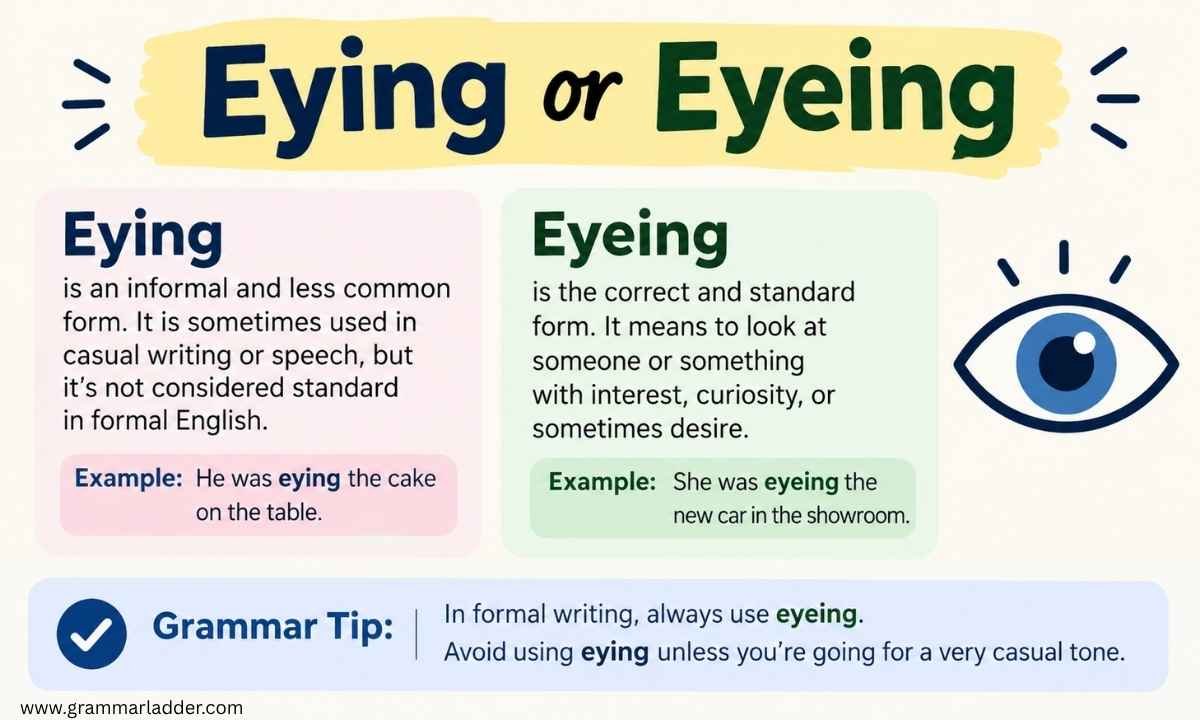
Eyeing and eying are both accepted spellings of the same word, and they mean the same thing. There’s no difference in meaning, tone, or grammar between them.
- Eyeing is the more common and widely preferred spelling, especially in American English and modern usage.
- Eying is an older, less common variant that’s technically correct but rarely used today.
If you want a simple rule to follow: when in doubt, write “eyeing.” It’s the safer, more recognizable choice for nearly every kind of writing.
Where Do These Words Come From?
Both spellings come from the base verb “eye,” which means to look at something carefully, watch it closely, or consider it (often with suspicion, desire, or interest). Think of sentences like “She eyed the last slice of cake” or “Investors are eyeing the new stock.”
The word “eye” traces back to Old English “ēage,” related to similar words in other Germanic languages like Dutch and German. When English speakers needed to turn “eye” into its present participle (the -ing form), a small spelling problem came up: how do you add “-ing” to a word that already ends in the letter “e”?
Normally, English drops the silent “e” before adding “-ing” (like “make” becoming “making”). But “eye” doesn’t have a silent “e” at the end — the “e” is actually pronounced as part of the word. This created two logical paths:
- Drop the “e” anyway, following the standard rule, giving us “eying.”
- Keep the “e” to avoid confusion and preserve the word’s recognizable shape, giving us “eyeing.”
Both paths were used historically, and neither one ever fully replaced the other.
Why Are There Two Spellings?
The two spellings exist because English spelling rules aren’t always consistent, especially with short, unusual-looking words. “Eye” is one of the rare English words made up mostly of vowels, and adding “-ing” to it doesn’t follow a clean, predictable pattern the way it does with most verbs.
Style guides and dictionaries eventually accepted both forms rather than forcing writers to pick one. Over time, though, “eyeing” pulled ahead in popularity because:
- It looks more like the original word “eye,” making it easier to recognize at a glance.
- It avoids the slightly awkward look of three vowels in a row (“eying”).
- Major style guides and editors gradually leaned toward it as the standard.
Meanwhile, “eying” survived mostly in older texts, formal or literary writing, and regions where traditional spelling conventions are still followed more closely.
The Meaning Is the Same
This is the most important thing to remember: there is zero difference in meaning between “eyeing” and “eying.” Both describe the act of looking at something or someone closely, often with a specific intention like desire, suspicion, curiosity, or careful observation.
For example:
- “He was eyeing the promotion for months.”
- “He was eying the promotion for months.”
Both sentences mean the same thing. Neither spelling changes the tense, tone, formality, or grammatical function of the word. This is different from words like “affect” and “effect,” which look similar but mean different things. With “eyeing” and “eying,” you’re just choosing between two accepted spellings of the identical word.
Comparison Table
| Feature | Eyeing | Eying |
| Meaning | To watch or look at closely | To watch or look at closely |
| Popularity | Much more common | Rare, mostly older usage |
| American English | Preferred spelling | Accepted but uncommon |
| British English | Widely used | Also accepted, slightly more traditional |
| Dictionary status | Listed as standard | Listed as valid variant |
| Formal writing | Recommended | Occasionally seen in literary text |
| Everyday use (emails, social media) | Standard choice | Rarely used |
| Search volume online | Significantly higher | Much lower |
Which One Should You Use?
Since both spellings are technically correct, the real question isn’t “which one is right” but “which one fits your writing situation best.” Here’s how to decide.
What should YOU write?
For almost every practical purpose — blogs, emails, business writing, social media, and everyday conversation — “eyeing” is the safer and more natural choice. It’s instantly recognizable, doesn’t slow readers down, and matches what most people expect to see.
If you are writing in American English:
Stick with “eyeing.” It’s the dominant spelling in American newspapers, websites, and books. Most American dictionaries, including Merriam-Webster, list “eyeing” as the primary or more frequently used form. Using “eying” in American content can look like a typo to readers, even though it isn’t one.
If you are writing in British English:
Both spellings are acceptable, but “eyeing” is still more common in modern British publications as well. “Eying” appears more often in classic or formal British literature, so it can carry a slightly old-fashioned feel. If you want your writing to feel current, “eyeing” remains the safer pick even across the Atlantic.
If you are not sure:
Default to “eyeing.” It works in nearly every context, avoids confusion, and won’t get flagged by spell-checkers, editors, or readers. When there’s genuine doubt about tone or audience, the more common spelling always wins.
Eyeing or eying: Oxford Dictionary
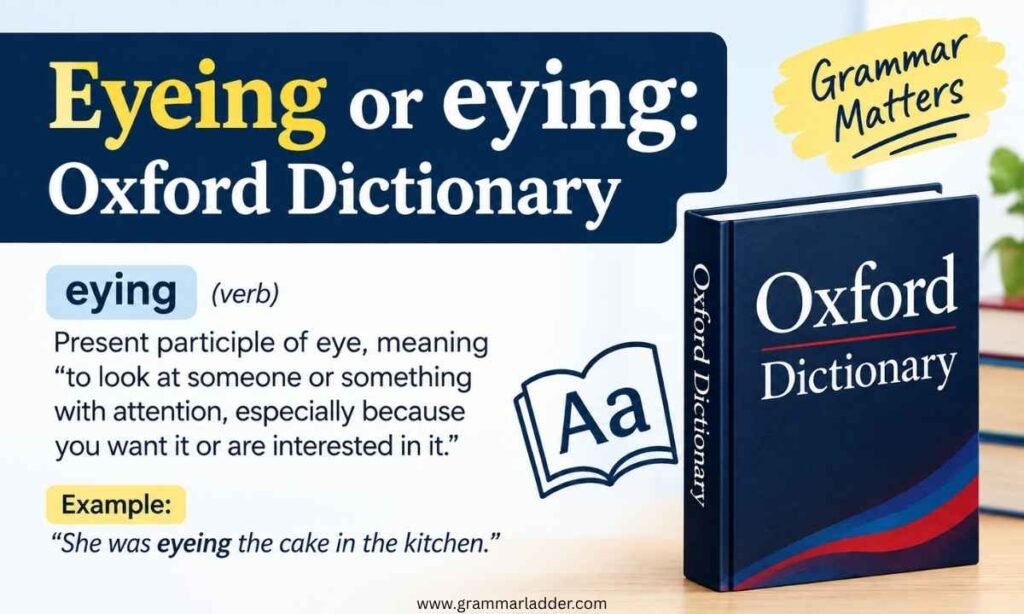
According to the Oxford Advanced Learner’s Dictionary, “eye” as a verb has two accepted -ing forms: eyeing and eying, listed side by side with identical pronunciation. Oxford doesn’t rank one as incorrect — both are recognized as standard forms of the word.
Eying or eyeing: synonyms
If you want alternatives to either spelling, common synonyms include: watching, observing, scrutinizing, eyeballing, studying, monitoring, and gazing at. These words work well as substitutes when you want to avoid repeating “eyeing” or “eying” too often in the same piece of writing.
Eying or Eyeing: AP style
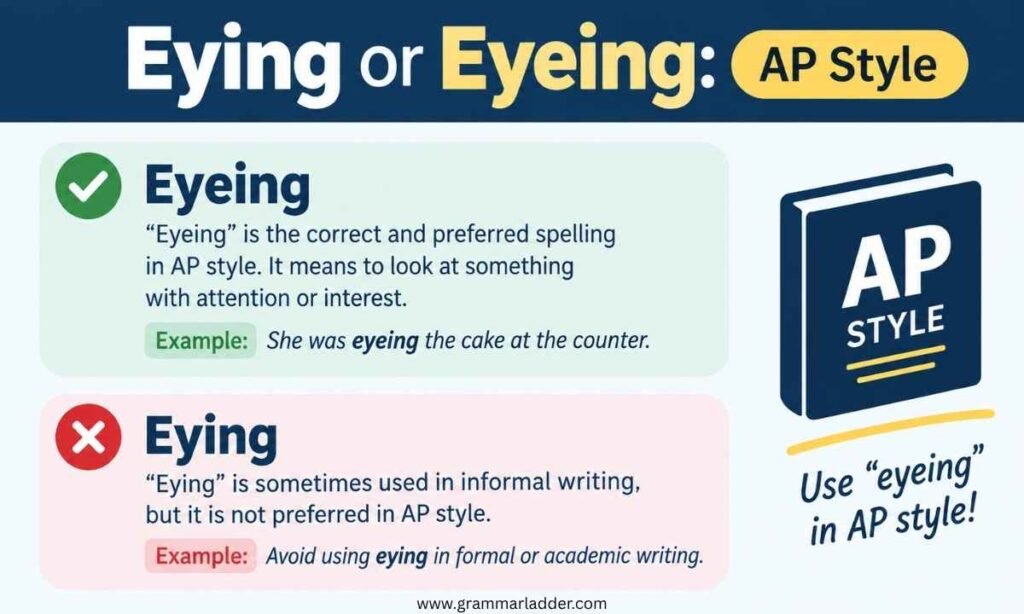
The Associated Press Stylebook, widely used in journalism and news writing, favors “eyeing” as the standard spelling. If you’re writing headlines or news copy and want to follow AP conventions, “eyeing” is the form to use.
Common Mistakes People Make
Even though this word isn’t complicated, a few mistakes come up again and again.
1. Thinking one spelling is wrong
Many writers assume “eying” must be a typo simply because it looks unusual. In reality, it’s a legitimate, dictionary-recognized spelling — just less common than “eyeing.”
2. Spelling it “eyeingg” or “eyeng”
Autocorrect and quick typing sometimes lead to extra or missing letters. Always double-check that you have exactly two “e”s and one “i” in “eyeing,” or one “e” and one “i” in “eying.”
3. Confusing “eyeing” with “seeing”
Because both words end in “-eing” or “-eing”-like patterns and relate to vision, some writers accidentally swap them. “Seeing” simply means perceiving with your eyes, while “eyeing” implies a closer, more intentional look, often with an underlying motive.
4. Forgetting the meaning
Some new English learners mistakenly think “eyeing” only applies to literal eye contact. In practice, it’s frequently used figuratively, as in “the company is eyeing expansion into new markets,” where no physical eye contact is involved at all.
Everyday Real Life Examples
Seeing how this word is actually used in daily life helps cement the spelling in your memory.
In Emails
“We’re eyeing a launch date sometime next month, pending final approval from the design team.”
In News Headlines
“Tech Giant Eyeing Acquisition of Rival Startup Amid Market Shakeup”
On Social Media
“Not me eyeing that new phone every time I open Instagram “
In Daily Conversations
“He’s been eyeing that job for weeks — I think he’s finally going to apply.”
Across all four contexts, “eyeing” is the natural, expected spelling. This consistency is exactly why it has become the default choice for most writers.
Simple Learning Section for Students
If you’re a student or English learner trying to remember this rule, here’s a simple breakdown.
Step 1: Think of the base word — eye
Everything starts with the noun and verb “eye,” meaning the organ you see with, or the action of looking closely at something.
Step 2: Add -ing
Because “eye” already ends in “e,” you have a choice: drop the “e” (eying) or keep it (eyeing). Both are allowed, but keeping it is the more common modern choice.
Easy Memory Trick
Picture the word “eye” hiding inside “eyeing” — you can literally see e-y-e at the start of the word. That visual cue makes “eyeing” easier to remember and spell correctly under pressure.
Practice Sentences
Try filling in the blank with either spelling (both are acceptable, but “eyeing” is recommended for consistency):
- The cat was ______ the fish tank from across the room.
- Investors have been ______ the company’s next big move.
- She kept ______ the clock, waiting for the meeting to end.
- The dog sat quietly, ______ every bite of food on the table.
Frequently Asked Questions
Is “eying” a real word?
Yes, “eying” is a recognized, dictionary-approved spelling of the verb “eye” in its -ing form.
Which spelling is more common, eyeing or eying?
“Eyeing” is far more common in modern writing, including American and British English.
Do “eyeing” and “eying” mean different things?
No, they have identical meanings and are used interchangeably in the same contexts.
Which spelling does AP style recommend?
AP style recommends “eyeing” as the standard spelling for news and journalistic writing.
Can I use “eying” in formal writing?
Yes, it’s grammatically correct, though “eyeing” is generally seen as the more modern and polished choice.
Does Oxford Dictionary accept both spellings?
Yes, Oxford lists both “eyeing” and “eying” as valid -ing forms of the verb “eye.”
Is one spelling British and the other American?
Not strictly. Both are used in both dialects, but “eyeing” dominates in both regions today.
What’s a simple synonym for “eyeing”?
Common alternatives include “watching,” “observing,” and “scrutinizing.”
Conclusion
At the end of the day, “eyeing” and “eying” are two correct spellings of the same word, and choosing between them comes down to consistency and audience expectations rather than right versus wrong. For nearly all modern writing — whether it’s a business email, a blog post, a news headline, or a casual text — “eyeing” is the recommended, widely accepted spelling.
“Eying” isn’t a mistake, but it’s less familiar to today’s readers and can come across as outdated or even look like a typo if used unexpectedly. So the next time you catch yourself pausing over this word, remember: both are technically fine, but “eyeing” is the smarter default for clear, modern, reader-friendly writing.

I am an English writer with over four years of experience in grammar and language education.
Through Grammar Ladder, I share clear explanations, practical examples, and helpful English tips.
My goal is to share my knowledge so others can benefit and improve their language skills.
I believe anyone can master English with proper guidance and consistent practice.