Two little words. One tiny apostrophe. Endless confusion.
“Whose” and “who’s” trip up even careful writers. They sound the same when spoken. But on paper, they do very different jobs, and mixing them up can make your writing look careless.
The good news? The difference is easy to learn once it clicks. “Whose” shows ownership. “Who’s” is just a short way of saying “who is” or “who has.” This guide breaks it down in plain, simple terms so you never second-guess yourself again.
Quick Answer
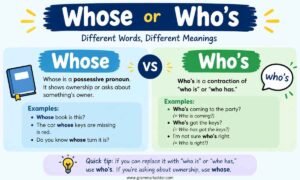
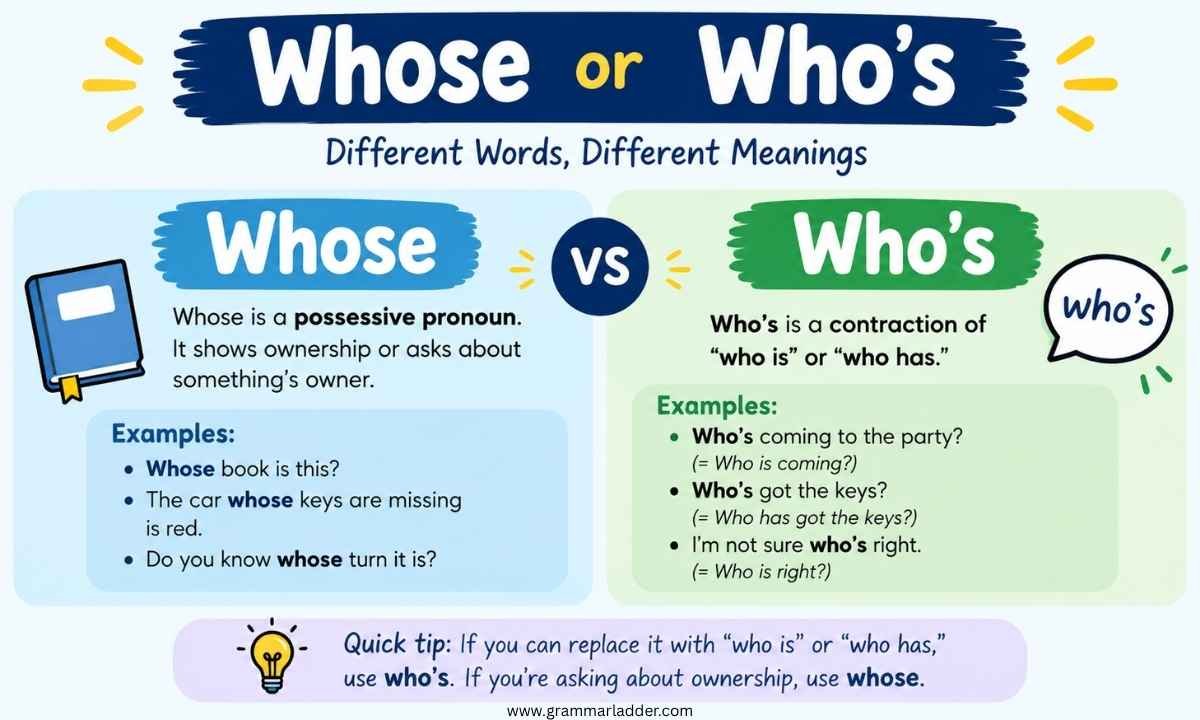
- Whose shows possession — it means “belonging to whom.”
- Who’s is a contraction of “who is” or “who has.”
- They sound identical, but they work completely differently in a sentence.
Simple Background
English has a small group of words that sound identical but are spelled differently and mean different things — these are called homophones.
- “Whose” and “who’s” are a classic example.
- Other common pairs include “its” and “it’s,” or “your” and “you’re.”
- The confusion happens because we hear apostrophes; we don’t hear them.
- So when people write quickly, the ear takes over from the eye, and the wrong word slips in.
Clear Explanation of the Difference
What is “Whose”?
“Whose” shows ownership. It tells you who something belongs to.
- Whose jacket is this?
- I met the author whose book won the award.
“Whose” never has an apostrophe. If you want to add one, stop. That’s a sign you might need “who’s” instead.
What is “Who’s”?
“Who’s” is short for “who is” or “who has.”
- Who’s coming to the party? (Who is coming…)
- Who’s already finished the report? (Who has already finished…)
The apostrophe stands in for missing letters. It works just like “don’t” (do not) or “it’s” (it is).
Comparison Table
| Phrase | Correct Word | Why |
| ___ Name | Whose | Shows possession of a name |
| As someone ___ | Whose | Introduces ownership |
| Guess ___ | Who’s | Short for “guess who is” |
| ___ Fault Is That | Whose | Asks who owns the fault |
Whose or Who’s Name
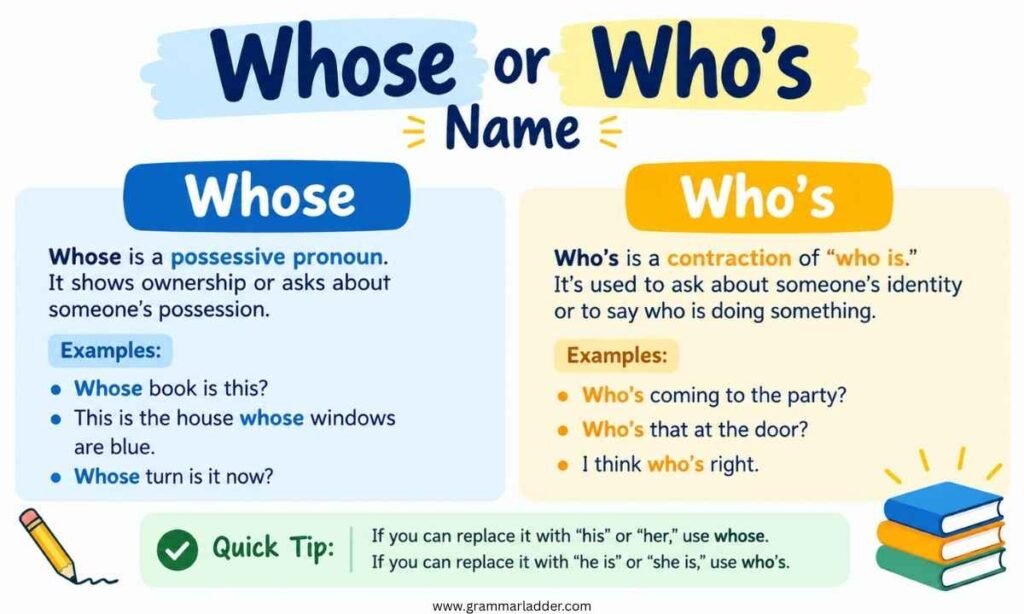
Whose name is correct. You’re asking who owns the name. “Whose name is on the list?”
Guess Whose or Who’s
Guess who’s is usually right. It’s short for “guess who is.” “Guess who’s at the door!” Use “whose” only when possession follows. “Guess whose idea this was.”
Whose or Who’s Fault Is That
Whose fault is that is correct. You’re asking who owns the fault. That’s possession, not a contraction.
As Someone Whose or Who’s
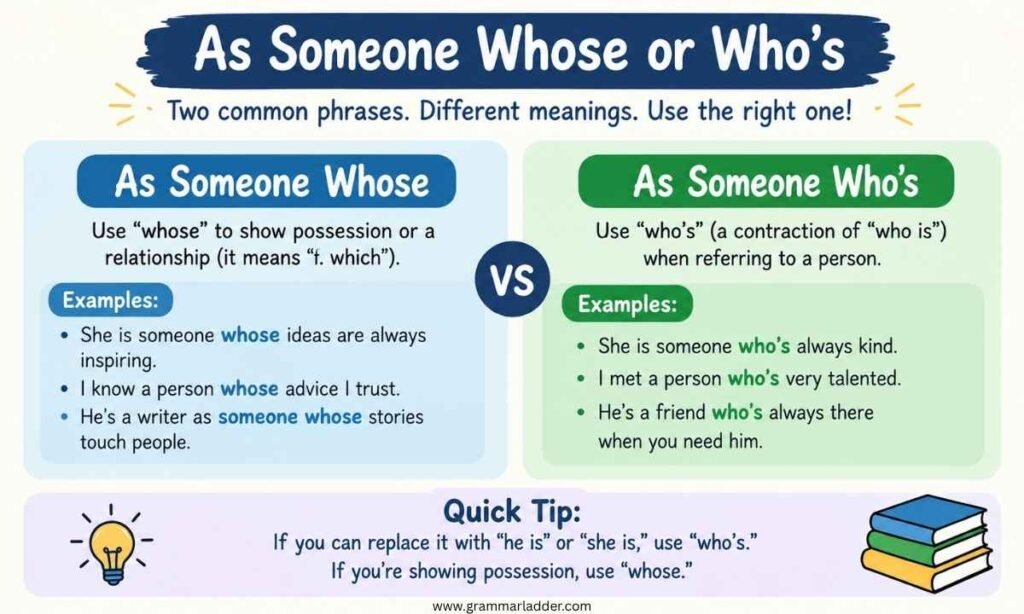
Someone whose is correct when a noun follows. “Someone whose car was towed called the office.” Use “who’s” only when you mean “who is.” “Someone who’s late should call ahead.”
Which One to Use and When
- Use whose when a noun follows that shows ownership. Example: whose car, whose turn.
- Use who’s when you can swap in “who is” or “who has” and the sentence still works.
Simple Tip to Remember
Say the sentence out loud. Swap in “who is.” Does it still make sense?
- If yes, use who’s. “Who is at the door?” → “Who’s at the door?”
- If no, use whose. “Who is book is this?” doesn’t work → “Whose book is this?”
Common Mistakes People Make
1. Using “who’s” for possession
People write “Who’s phone is this?” instead of “Whose phone is this?” This happens because the sound tricks the ear.
2. Forgetting the apostrophe’s meaning
Some writers think every possessive needs an apostrophe, like “dog’s” or “Sarah’s.” But “whose” is already possessive. No apostrophe needed.
3. Mixing sound with spelling
Since both words sound the same, people type whichever comes to mind first. They forget to check the meaning.
Everyday Real-Life Examples
In Emails
- “Please confirm who’s handling the client call tomorrow.”
- “I need to know whose signature is required on this document.”
In Messages
- “Who’s free this weekend?”
- “Whose turn is it to pick the restaurant?”
On Social Media
- “Guess who’s back!”
- “Tag someone whose energy always makes your day better.”
In Daily Life
- “Who’s driving to the airport?”
- “Whose keys are these on the counter?”
Short Learning Section for Students
Step 1: Learn the Rule
Remember this: whose shows ownership. who’s means “who is” or “who has.” No apostrophe means ownership. An apostrophe means something is missing.
Step 2: Practice
Fill in the blanks:
- ___ turn is it next? (who’s)
- ___ backpack is this? (whose)
- ___ been calling me all day? (who’s)
- I don’t know ___ idea this was. (whose)
Frequently Asked Questions
Is “whose” only used for people?
No. “Whose” can also refer to objects or ideas. “The company whose stock rose” is correct, even though a company isn’t a person.
Can “who’s” mean “who has”?
Yes. “Who’s taken my pen?” means “Who has taken my pen?”
Is there a trick that always works?
Yes. Try swapping in “who is.” If it fits, use “who’s.” If it sounds wrong, use “whose.”
Do native speakers get this wrong too?
Yes, often. It’s one of the most common mix-ups in English, even for fluent writers. The mistake is about spelling, not understanding.
Does spell-check catch this mistake?
Not always. Both “whose” and “who’s” are correctly spelled words, so basic spell-check won’t flag them. You need grammar-check tools or your own careful reading to catch the error.
Conclusion
The difference comes down to one simple test. Does the sentence mean “who is” or “who has”? If yes, use who’s. If you’re asking who owns something, use whose. Once this small check becomes a habit, the mistake disappears for good.

I am an English writer with over four years of experience in grammar and language education.
Through Grammar Ladder, I share clear explanations, practical examples, and helpful English tips.
My goal is to share my knowledge so others can benefit and improve their language skills.
I believe anyone can master English with proper guidance and consistent practice.