You are typing a quick message. “See you tomorrow” or “See you tommorrow”? Your fingers hesitate, and the word suddenly looks wrong.
“Tomorrow” is the only correct spelling. “Tommorrow” is a common misspelling that does not exist in standard English.
This guide explains why the double “m” is a mistake, where the word comes from, and how to spell it correctly every time. You will also find examples, a comparison table, memory tricks, and quick FAQs.
The Correct Spelling: “Tomorrow”
The correct spelling is T-O-M-O-R-R-O-W. It has:
- One “m”
- Two “r”s
- Three “o”s
- Eight letters in total
Every major dictionary, including Merriam-Webster, Oxford, Cambridge, and Collins, lists only this form. It is the same in American, British, Canadian, and Australian English.
Quick rule: tomorrow = to + morrow. Split it that way, and the spelling falls into place.
Why Is “Tommorrow” Incorrect?
“Tommorrow” breaks the word’s structure. It puts the double letter in the wrong place.
The mistake usually has three causes:
- Misplaced doubling. English has many double-letter words, such as committee, accommodate, and tomorrow. Writers know a word has a double letter, but not which one.
- Sound confusion. When we say the word aloud, the “m” and “r” sounds blend, so the stress falls unclearly.
- Visual habit. Words like tomato and tomb start with “tom,” which pulls the eye toward “tomm.”
Here is how the two forms break down:
| Part | Correct | Incorrect |
| Prefix | to | tom |
| Root | morrow | morrow (but with an extra “m”) |
| Double letter | rr | mm |
| Result | tomorrow | tommorrow |
The double “m” is the mistake. The double “r” is the fix.
Origin and Etymology of “Tomorrow”
The spelling makes more sense once you see the word’s history.
“Tomorrow” comes from Old English. It began as the phrase to morgenne, meaning “on the morrow” or “in the morning.” The word morgen meant “morning,” and to worked like the modern “at” or “on.”
Over time the pieces changed:
- Morgen softened into morrow, an old word for “the following day.”
- “To morrow” was written as two words, then as a hyphenated form, “to-morrow.”
- By the early twentieth century, the hyphen dropped out and the single word “tomorrow” became standard.
You can still see the old form in classic literature, where “to-morrow” appears with a hyphen. The word “morrow” survives today in poetic phrases such as “on the morrow.”
That history explains why “morrow” has one “m.” The word was never “tom” plus “morrow.” It was always “to” plus “morrow.”
Tomorrow or Tommorrow in English
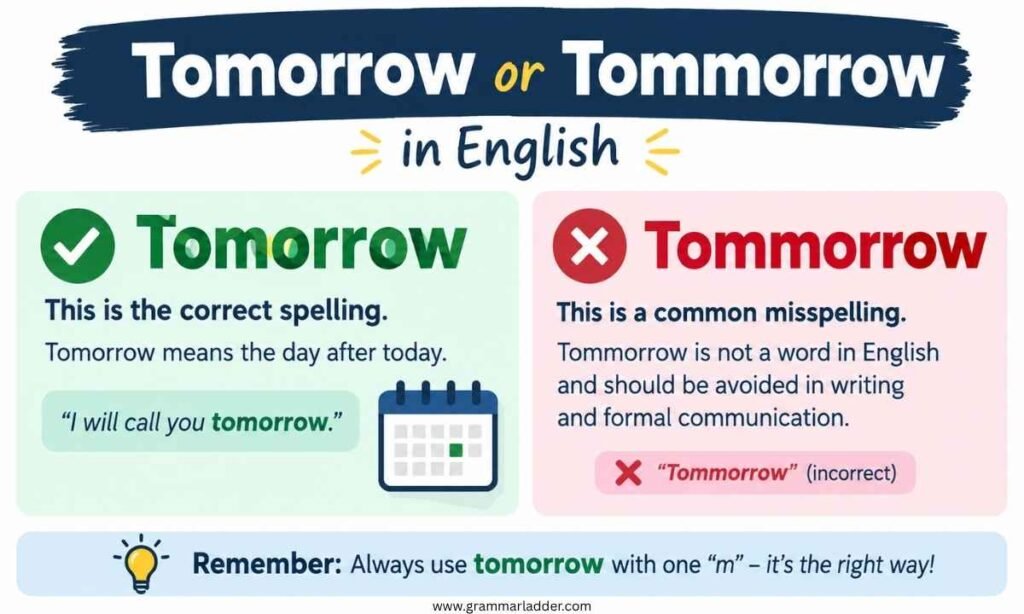
Standard English recognizes only one form. Here is how each variation is treated:
- Tomorrow: Listed in every major dictionary and accepted in formal writing.
- Tommorrow: Not recognized in dictionaries and not acceptable in formal writing.
- Tomorow: Not recognized in dictionaries and not acceptable in formal writing.
- Tommorow: Not recognized in dictionaries and not acceptable in formal writing.
- To-morrow: Found only in older texts and considered archaic today.
Common Mistakes and Confusions
Writers usually miss the word in one of four ways.
1. Tommorrow (double “m,” double “r”)
This is the most common error. The writer doubles both letters.
2. Tomorow (single “r”)
Here the second “r” is dropped. It looks simpler but is still wrong.
3. Tommorow (double “m,” single “r”)
This mixes both errors into one.
4. Tomarrow or Tomorrow with an “a”
The unstressed vowel sound tricks writers into using “a.”
Other words with the same trap include:
- Committee (double m, double t)
- Occurrence (double c, double r)
- Address (double d, double s)
- Embarrass (double r, double s)
If you struggle with doubled letters in general, you are not alone. English has hundreds of these words, and the doubling rules have many exceptions.
Memory Aids and Tricks for Correct Spelling
Small tricks help more than long rules. Try these.
Trick 1: Break It in Two
Say it as to + morrow. “Morrow” has one “m” and two “r”s. Add “to” in front, and you have the full word.
Trick 2: Count the Rs
Remember: “Two Rs, one M.” Repeat it a few times and it sticks.
Trick 3: Use a Sentence Mnemonic
“To Old Men, Old Rules Rarely Others Welcome.” Each first letter matches T-O-M-O-R-R-O-W. It is silly, and that is why it works.
Trick 4: Link It to “Morning”
Both words come from the same old root. “Morning” and “morrow” both start with one “m.” Think of tomorrow as “to the morning.”
Trick 5: Write It Three Times
Physical repetition builds muscle memory. Type or write the word three times correctly, and your hand will remember it.
Tomorrow or Tommorrow Meaning
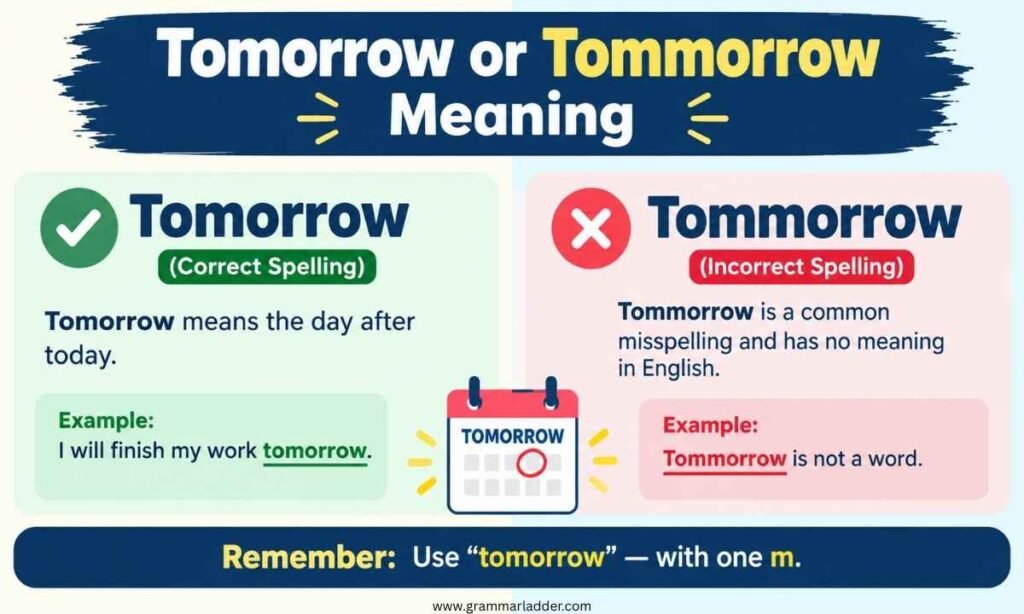
“Tomorrow” means the day after today. It can also mean the near or distant future in general.
Dictionaries list two main senses:
- The next calendar day: “I’ll call you tomorrow.”
- The future: “We are building a better tomorrow.”
“Tommorrow” has no meaning because it is not a real word. A reader will usually guess what you meant, but it looks like a typing error.
Side-by-Side Comparison: Tomorrow vs Tommorrow
| Feature | Tomorrow | Tommorrow |
| Correct spelling | ✅ Yes | ❌ No |
| Found in dictionaries | Yes | No |
| Number of “m”s | 1 | 2 |
| Number of “r”s | 2 | 2 |
| Origin | Old English to morgenne | Spelling error |
| Meaning | The next day; the future | None |
| Safe for formal writing | Yes | No |
| Looks professional | Yes | No |
The only real difference is that extra “m.” That one letter separates correct from incorrect.
Real-World Usage Examples
Here is how the word looks in everyday writing.
Correct sentences:
- “The deadline is tomorrow at noon.”
- “I will send the report tomorrow morning.”
- “Tomorrow is supposed to be sunny.”
- “What are you doing tomorrow night?”
- “Never put off until tomorrow what you can do today.”
Incorrect sentences:
- ❌ “The deadline is tommorrow at noon.”
- ❌ “I will send the report tommorrow morning.”
- ❌ “Tommorrow is supposed to be sunny.”
Professional email example:
Hi Sarah, I’ll share the updated proposal tomorrow by 10 a.m. Please let me know if you need anything before then.
The word appears in emails, job applications, texts, school essays, and news articles. A wrong spelling in any of them takes attention away from your message.
Impacts of Incorrect Spelling
A small typo can have a bigger effect than you expect.
- First impressions: Misspellings in a cover letter or email can make you look careless.
- Credibility: Readers trust polished writing more. Errors reduce that trust.
- Business results: Website typos can hurt customer confidence and conversions.
- Academic scores: Teachers often mark spelling in essays and exams.
- Search visibility: People who search for “tommorrow” often land on correction pages. If you publish a page with the wrong spelling, you may attract the wrong audience.
One typo will not ruin your reputation. Repeated typos, though, can quietly weaken it.
Auto-Correct and Spell-Check Limitations
Spell-check catches “tommorrow” most of the time, but you shouldn’t rely on it fully.
Here is where tools fall short:
- Auto-correct can fail when a misspelling is too far from the real word.
- Predictive text may learn your mistakes if you accept them often.
- Custom dictionaries can store a wrong word if you click “Add to dictionary” by accident.
- Voice typing may write the right word, but you may not see the error if you don’t proofread.
- Different tools have different rules, and some ignore certain fields such as form inputs, captions, and image text.
Also, spell-check only checks whether a word exists. It does not check whether you used the right one. That is why proofreading is still important.
Correct Usage in Context
Use “tomorrow” in these common situations.
Scheduling
“Our appointment is tomorrow at 3 p.m.”
Time phrases
- Tomorrow morning
- Tomorrow afternoon
- Tomorrow evening
- Tomorrow night
- The day after tomorrow
Idioms and expressions
- “Tomorrow never comes.”
- “Here today, gone tomorrow.”
- “Tomorrow is another day.”
Capitalization
Do not capitalize “tomorrow” unless it starts a sentence or appears in a title.
Punctuation
No comma is needed after a short opening “tomorrow”: “Tomorrow we leave for Lahore.” A comma is fine in longer sentences for clarity.
Practical Tips for Avoiding Mistakes
Follow this short checklist to protect your writing.
- Split the word. Think “to + morrow” every time.
- Slow down on common words. Simple words cause the most careless errors.
- Proofread once out loud. Your ear catches what your eyes skip.
- Read backward. Checking word by word removes the flow that hides typos.
- Use a spell-checker, but verify. Treat it as a helper, not a guarantee.
- Check your custom dictionary. Remove any wrong words you added earlier.
- Keep a personal error list. Note the words you misspell most and review them weekly.
- Take a short break. Fresh eyes spot mistakes faster.
Most people fix this habit within a few days once they pay attention to it.
Frequently Asked Questions
Is it “tomorrow” or “tommorrow”?
“Tomorrow” is correct. “Tommorrow” is a misspelling.
How many “m”s and “r”s are in tomorrow?
It has one “m” and two “r”s.
Is “tommorrow” ever acceptable?
No. No standard dictionary accepts it, even informally.
What is the origin of the word “tomorrow”?
It comes from Old English to morgenne, meaning “on the morrow” or “in the morning.”
Is “to-morrow” with a hyphen correct?
It is an old form. Modern English uses the single word “tomorrow.”
Conclusion
“Tomorrow” is the correct spelling. “Tommorrow” is a common mistake. Remember it has one “m” and two “r”s. Think of it as “to” plus “morrow,” and the spelling becomes easy.
Small typos can hurt how people see your writing. A quick proofread takes only a few seconds. Do not rely on spell-check alone. Now you know the right spelling, so type “tomorrow” with confidence.

I am an English writer with over four years of experience in grammar and language education.
Through Grammar Ladder, I share clear explanations, practical examples, and helpful English tips.
My goal is to share my knowledge so others can benefit and improve their language skills.
I believe anyone can master English with proper guidance and consistent practice.