You are typing an email, and your fingers pause. Is it “amount” or “ammount”? Two m’s look right, but one feels safer. This tiny doubt trips up students, professionals, and even programmers.
This guide settles it fast. You will get the correct spelling, the meaning, the word’s history, clear examples, and simple memory tricks.
Amount or Ammount – Quick Answer
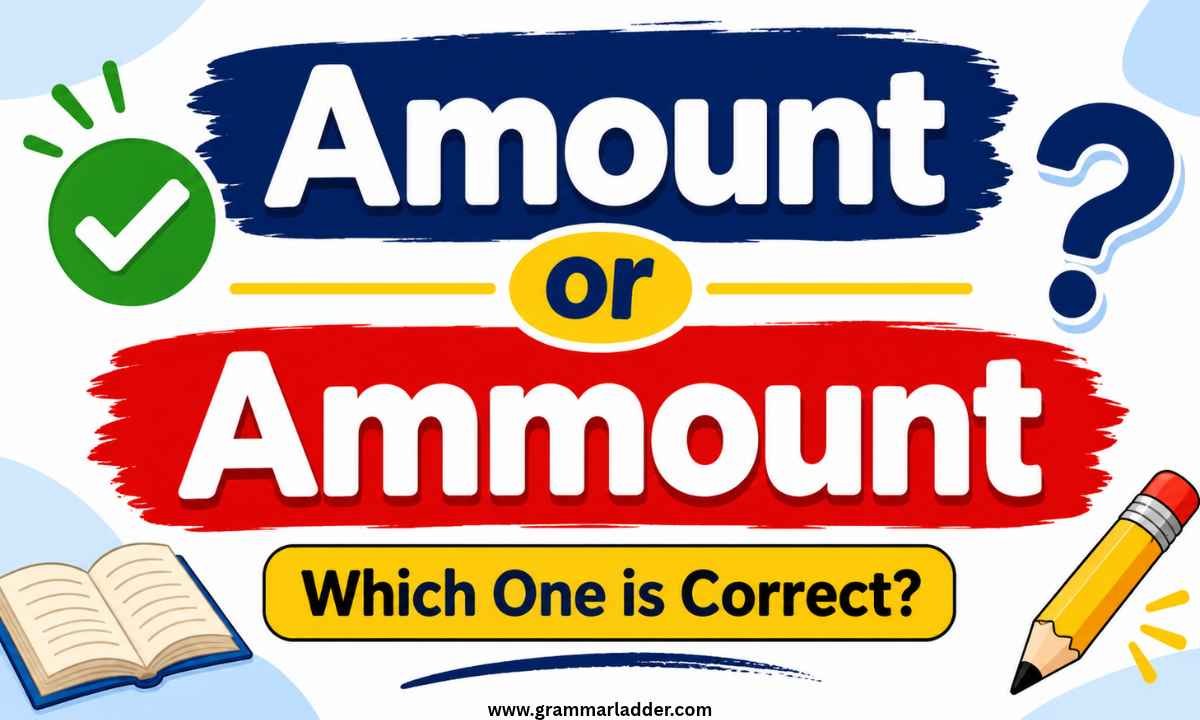
“Amount” is the only correct spelling. “Ammount” is a common misspelling and is not accepted in standard English, whether British or American.
- ✅ Amount: one m, one o, one u, one n, one t
- ❌ Ammount: the double m is a typo
A quick way to remember it: a-MOUNT. The word ends in “mount,” like a mountain. Only one m sits in front of it.
Ammount or Amount Meaning
The word “ammount” has no meaning because it is not a real English word. It only appears by mistake.
“Amount” works as both a noun and a verb:
- Noun: a total, sum, or quantity of something. The amount of sugar in this cake is too high.
- Noun (money): a sum of money. Please check the amount before you pay.
- Verb: to add up to, or to be equal to. His efforts amount to a real change.
Common synonyms include quantity, sum, total, volume, and figure.
The Origin of Amount or Ammount
- Why it helps: knowing where a word comes from makes the spelling easier to remember.
- Old French root: “amount” entered English from the verb amonter, meaning “to go up” or “to rise.”
- Earlier phrase: amonter grew from a mont, meaning “upward” or “to the mountain.”
- Latin origin: that phrase traces back to ad montem.
- Word family: the root is mont, shared with mount, mountain, and paramount.
- No double m: none of these related words has a double m.
- Why “ammount” appears: the extra m probably comes from pronunciation and common typing habits.
British English vs American English Spelling
Some words change between regions, such as colour and color. “Amount” is not one of them.
| Feature | British English | American English |
| Correct spelling | amount | amount |
| Is “ammount” accepted? | No | No |
| Pronunciation | /əˈmaʊnt/ | /əˈmaʊnt/ |
| Word class | Noun, verb | Noun, verb |
Whether you write for a UK, US, Canadian, or Australian audience, the spelling stays the same.
Amount or Ammount: Which Is Correct?
Only amount is correct. Spell-checkers in Microsoft Word, Google Docs, and Grammarly flag “ammount” with a red underline right away.
The mistake is common because the word sounds like it starts with a short, doubled “am.” English also has many double-letter words, such as committee, accommodate, and recommend. Writers often add a second m by habit. Here, the rule does not apply.
Amount or Ammount in English
In everyday English, “amount” shows up in many places:
- Finance: total amount, amount due, loan amount, outstanding amount
- Cooking: a small amount of salt
- Science: the amount of rainfall, a trace amount of a chemical
- Daily talk: a fair amount of time, a huge amount of work
In business writing, a misspelling can look careless. On an invoice, contract, or resume, “ammount” can hurt your credibility.
Amount or Ammount Grammar
Spelling is only half the story. Grammar matters too.
Amount vs. Number
Use amount with things you cannot count one by one (uncountable nouns). Use number with things you can count (countable nouns).
| Use | With | Example |
| amount of | uncountable nouns | the amount of water, the amount of time |
| number of | countable nouns | the number of students, the number of cars |
Is “Amount” Singular or Plural?
“Amount” is a singular noun. The plural form is “amounts,” used when you mean several sums or quantities.
- The amount is correct.
- The amounts were added to the bill.
“Amount of” and Verb Agreement
The verb should match the thing being measured.
- A large amount of money was stolen. (money is uncountable, so the verb is singular)
Amount or Ammount Oxford Dictionary
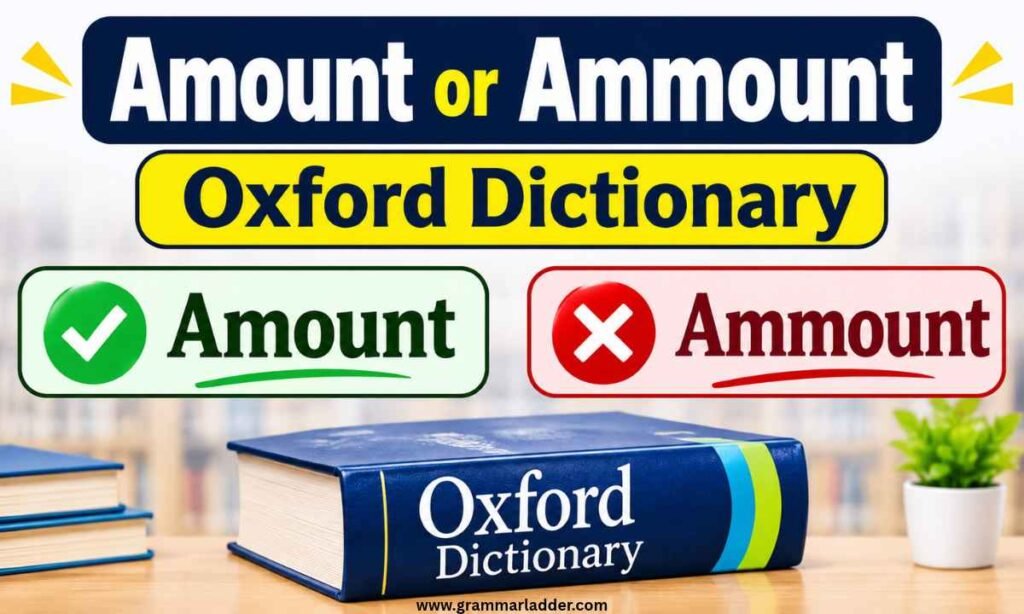
Major dictionaries, including Oxford, Cambridge, Merriam-Webster, and Collins, list only amount. None of them record “ammount” as a valid variant, and spell-checkers treat it as an error.
If you ever doubt a spelling, check a trusted dictionary instead of relying on memory. Look for the headword, the part of speech, and the example sentences.
Common Mistakes with Amount or Ammount
These are the errors writers make most often:
- Doubling the m: writing “ammount” instead of “amount.”
- Using “amount” with countable nouns: “the amount of people” should be “the number of people.”
- Mixing up “amount” and “account”: the two look alike but mean different things. An account is a record or a report, while an amount is a quantity.
- Writing “amounts” when one sum is meant: use the singular unless you mean several quantities.
- Copying typos in code: “ammount” often appears in variable names. Later fixes and renames cost time, so spell it right from the start.
Quick Memory Tricks
- Think “a MOUNT”: a mountain has one m before it.
- Say it slowly: uh-MOUNT. The stress falls on the second syllable.
- Remember that “amount” ends the same way as “count” (-ount), which hints at quantity.
Amount or Ammount Examples
Correct Sentences
- Please confirm the total amount before you make the payment.
- A small amount of oil is enough for this recipe.
- The amount of homework this week is heavy.
- Her savings amount to nearly ten thousand dollars.
- There is a surprising amount of noise outside.
Incorrect Sentences (and Fixes)
- Incorrect: The ammount due is $50.
- Correct: The amount due is $50
- Incorrect: I need a small ammount of flour
- Correct: I need a small amount of flour.
- Incorrect: What is the ammount of the invoice?
- Correct: What is the amount of the invoice?
- Incorrect: The amount of cars is growing
- Correct: The number of cars is growing.
Amount or Ammount Comparison Table
Here is a quick side-by-side view.
| Point | Amount | Ammount |
| Correct in English? | Yes | No |
| Found in dictionaries? | Yes | No |
| Word class | Noun, verb | None |
| Origin | Old French amonter | Misspelling |
| Accepted in UK and US? | Yes | No |
| Use in formal writing | Safe | Avoid |
Frequently Asked Questions
Is it “amount” or “ammount”?
The correct spelling is “amount.” “Ammount” is a misspelling.
Does “ammount” have any meaning?
No. It is a typo with no meaning in English.
Is “amount” spelled differently in British and American English?
No. Both varieties use the same spelling.
Is “amount” singular or plural?
It is singular. The plural is “amounts.”
When should I use “amount” instead of “number”?
Use “amount” for uncountable things like water or time, and “number” for countable things like books or people.
Why do people write “ammount”?
Most people add a second m by habit, because many English words have doubled letters.
How can I remember the right spelling?
Think of “a-mount,” like a mountain, with only one m in front.
What is the origin of the word “amount”?
It comes from Old French amonter, meaning “to go up,” from the Latin phrase ad montem.
Conclusion
The answer is simple: “amount” is correct, and “ammount” is always wrong. The word comes from the same root as “mountain,” which has only one m in front, and both British and American English follow that spelling.
Remember the grammar too. Use “amount” with uncountable nouns and “number” with countable ones. Keep the “a-mount” trick in mind, and run a quick spell-check before you publish or send anything important.

I am an English writer with over four years of experience in grammar and language education.
Through Grammar Ladder, I share clear explanations, practical examples, and helpful English tips.
My goal is to share my knowledge so others can benefit and improve their language skills.
I believe anyone can master English with proper guidance and consistent practice.