Plenty of people stop and think before typing this word. Is it consensus or concensus? The letters s and c sound the same, so it is easy to mix them up. You have probably seen the wrong spelling in emails, essays, and even news posts.
The correct spelling is consensus. “Concensus” is just a common mistake. In this guide, you will learn why the error happens and how to avoid it. You will also get simple examples, pronunciation tips, and a quick memory trick.
Consensus or Concensus: Meaning
Consensus is a noun. It means a general agreement among a group of people.
Dictionaries such as Merriam-Webster and Oxford define it as the opinion or position held by most members of a group. It can also describe the process of reaching that agreement.
Quick answer:
- Consensus is the correct spelling. It means general agreement in a group.
- Concensus is incorrect. It is not a real word, just a spelling error.
The word comes from the Latin consensus, which means “agreement” or “accord.” It traces back to consentire, meaning “to feel together.”
Why Is Concensus Incorrect?
“Concensus” is wrong because it doesn’t match the word’s Latin root. The root is consent-, which gives us the s in the middle: con-sens-us.
Here is a simple way to see it. The word contains “sens,” as in “sense” and “consent.” People who agree sense the same thing.
Many writers also try to apply the “con-cen” pattern they know from other words:
- Concentrate
- Concentric
- Concentration
Those words come from the Latin centrum (center). “Consensus” has a different origin entirely, so the spelling pattern doesn’t carry over.
Memory trick: Think of the phrase “con-SENSE-us.” If you can spot “sense” or “consent” inside the word, you’ll spell it right.
Consensus vs Concensus in a Sentence
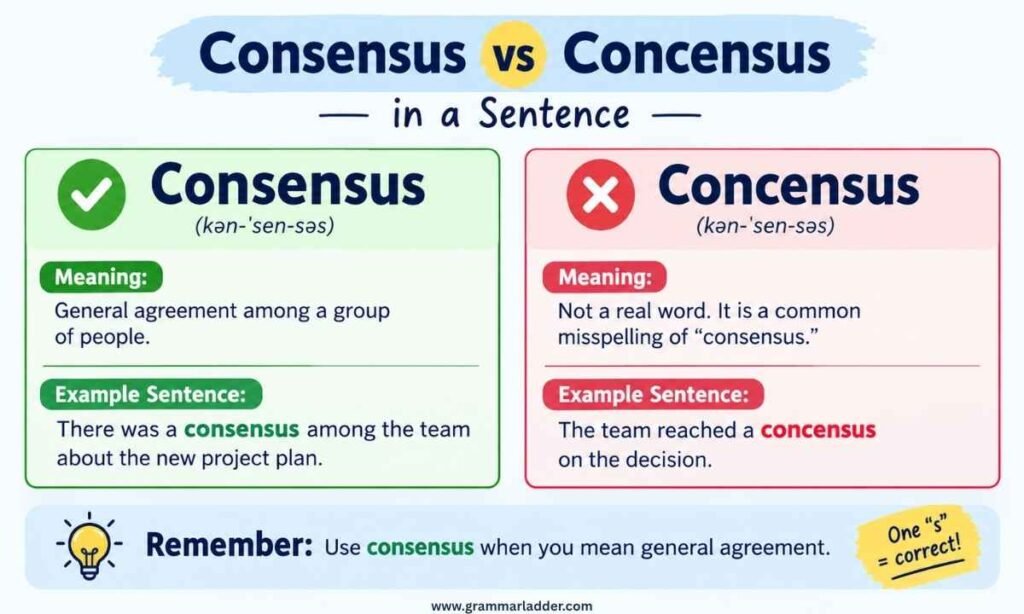
Seeing the words in context makes the difference obvious.
Correct:
- The committee reached a consensus after two hours of discussion.
- There is no consensus among doctors on this treatment.
- We need team consensus before launching the project.
Incorrect:
- ❌ The committee reached a concensus after two hours.
- ❌ There is no concensus among doctors on this treatment.
Notice that the correct form works as a noun in every example. You can reach it, build it, or lack it.
How Do You Pronounce Consensus?
Consensus is pronounced kun-SEN-sus (/kənˈsɛnsəs/).
Here is the breakdown:
- kun is a short, unstressed syllable
- SEN is the stressed syllable
- sus is another short, unstressed syllable
The stress falls on the middle syllable. Hearing that clear “sen” sound is a handy way to remember the spelling. If you say “kon-CEN-sus” in your head, you’re more likely to write the c by mistake.
Consensus Meaning in Simple English
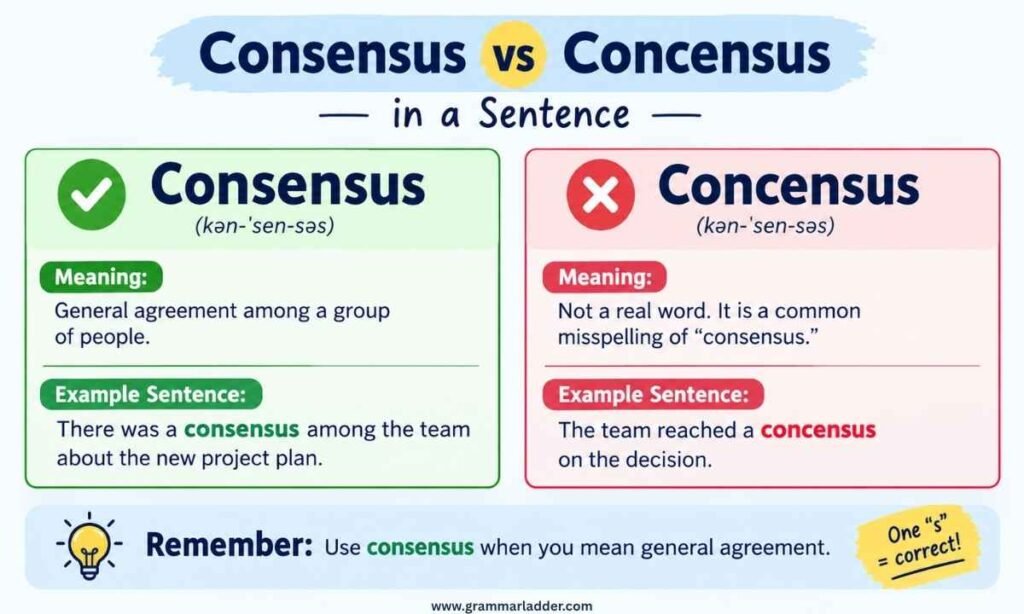
In plain terms, consensus means most people agree.
Imagine five friends deciding where to eat. Four want pizza, and one is fine with that. The group has reached a consensus: pizza.
You can also use the word in professional situations:
- Business: Managers reach a consensus on a budget.
- Science: Researchers share a consensus on a well-tested theory.
- Daily life: A family agrees on vacation dates.
It’s a useful word because it describes shared opinion without requiring everyone to feel strongly about it.
Consensus Does Not Always Mean Complete Agreement
A common misunderstanding is that consensus means everyone agrees. That isn’t always true.
In many settings, consensus means the group has settled on a decision that everyone can accept or support, even if some people have reservations. Some members may not love the result but are willing to go along with it.
Consensus vs. unanimity:
| Term | What it means |
| Consensus | General agreement; most or all accept the outcome |
| Unanimity | Every single person fully agrees |
| Majority | More than half vote in favor |
So a group can have a consensus without a unanimous vote. This distinction matters in meetings, legal discussions, and scientific debates, where the exact wording carries weight.
Common Phrases With Consensus
Consensus appears in many everyday expressions. Here are the most common ones:
- Reach a consensus: to come to an agreement
- Build consensus: to work toward agreement step by step
- Broad consensus: agreement among a wide range of people
- Scientific consensus: the shared position of most experts in a field
- Consensus decision: a choice made by group agreement rather than a vote
- Lack of consensus: no clear agreement
- Consensus opinion: the view most people share
You may also see “consensus.” Some style guides call this redundant, since consensus already means general agreement. It’s still widely used in speech and informal writing, but “consensus” alone is cleaner.
Consensus in American English
The spelling is the same in American and British English. Unlike words such as “color” and “colour,” there is no regional variation. Both varieties use consensus.
In American English, the word appears often in:
- Politics and government: “There is bipartisan consensus on the bill.”
- Business: “The board is working toward consensus.”
- Science and health: “The medical consensus supports vaccination.”
- Journalism: “Analysts have no consensus on the forecast.”
Related words are worth knowing too. The adjective consensual means “by mutual consent,” and it carries a different meaning from consensus. Don’t use the two interchangeably.
Why Do People Spell Consensus as Concensus?
The mistake is understandable. Several things push writers toward it.
- Sound-alike letters. The s and c both make an “s” sound in English, so the ear can’t tell them apart.
- Pattern matching. Words like “concentrate” and “concern” start with con- followed by a c or s sound, which creates confusion.
- Similar words. “Census” looks like the end of “consensus,” and many people mix up the two.
- Autopilot typing. When writing quickly, fingers often follow familiar patterns instead of the correct one.
- Hearing before reading. People often learn the word in meetings or on the news before seeing it written down.
Knowing why the error happens makes it easier to catch.
Consensus vs Concensus: Common Writing Mistakes
Beyond the main misspelling, writers make several related errors.
| Mistake | Correct form |
| Concensus | Consensus |
| Consensous | Consensus |
| Consenus | Consensus |
| Consensus of opinions | Consensus |
| Census (when meaning agreement) | Consensus |
Census vs. consensus deserves special attention:
- Census: an official count of a population
- Consensus: a general agreement
They sound slightly alike but have nothing in common. A census counts people. A consensus describes what they agree on.
Examples of Consensus in Everyday Writing
Here are realistic examples across different contexts.
Workplace email:
“Before we finalize the schedule, let’s reach a consensus on the deadline.”
School essay:
“There is a strong scientific consensus that climate change is influenced by human activity.”
News report:
“City council members failed to reach a consensus on the new zoning plan.”
Casual conversation:
“The consensus in our group chat is that Friday works best.”
Meeting notes:
“Consensus: move the launch to March.”
Each example uses the correct spelling and shows how flexible the word is.
How to Correct the Mistake Automatically
You don’t need perfect memory to avoid this error. These tools and habits will catch it.
Tools:
- Spell checkers: Word, Google Docs, and most email apps flag “concensus” with a red underline.
- Grammarly and similar tools: they suggest the correct spelling instantly.
- Autocorrect: add “concensus” as a custom entry that replaces itself with “consensus.”
- Find and replace: run a quick search before publishing any document.
Habits:
- Use the memory trick: con-SENSE-us.
- Read your draft aloud and listen for the stressed “sen” syllable.
- Search the word in your document before sending it.
- Keep a short list of words you often misspell.
With a little practice, the right spelling becomes automatic.
Frequently Asked Questions
Is “concensus” ever correct?
No. “Concensus” is always a misspelling of “consensus.”
What is the correct spelling: consensus or concensus?
The correct spelling is “consensus,” with an s in the middle.
What does consensus mean?
Consensus means a general agreement among a group of people.
How do I remember the spelling of consensus?
Think “con-SENSE-us.” The word “sense” sits right in the middle.
Is “consensus” correct?
It’s widely used, but some writers consider it redundant. “Consensus” alone is cleaner.
What is the difference between consensus and census?
A census is an official population count, while consensus means group agreement.
Does consensus mean everyone agrees?
Not always. It means the group has reached a position most or all members can accept.
Is consensus spelled differently in British English?
No. British and American English both use “consensus.”
Conclusion
The correct spelling is consensus, never “concensus.” The word comes from Latin and means general agreement. A simple way to remember it is con-SENSE-us, since “sense” and “consent” both sit inside it.
Remember that consensus doesn’t always mean everyone agrees. It means the group has found common ground. Keep it separate from “census,” and skip the redundant “consensus” when you want tighter writing.

I am an English writer with over four years of experience in grammar and language education.
Through Grammar Ladder, I share clear explanations, practical examples, and helpful English tips.
My goal is to share my knowledge so others can benefit and improve their language skills.
I believe anyone can master English with proper guidance and consistent practice.