You are typing fast, the sentence flows, and then a red line appears under a word. Was it “coming” or “comming”? It is a tiny slip, but it shows up in emails, school essays, and social media posts every day.
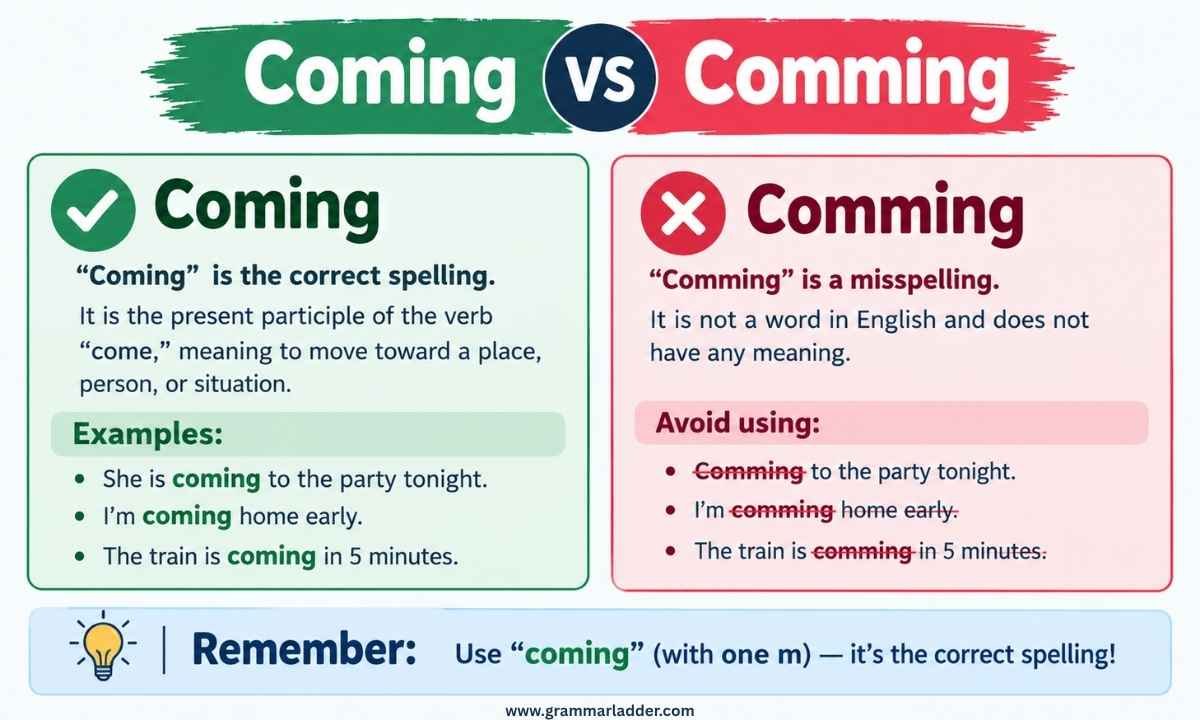
The short answer: “coming” is the only correct spelling. “Comming” is not a word in English, in either British or American usage. This guide explains why, shows you how the spelling rule works, and gives you easy tricks so you never second-guess it again.
Quick Answer: Coming vs Comming
| Spelling | Correct? | Why |
| Coming | Yes | Formed from “come” by dropping the silent e and adding -ing |
| Comming | No | The double m has no basis in English spelling rules |
What Does Coming Mean?
“Coming” is the present participle of the verb “come.” It describes an action that is happening now, will happen soon, or is approaching. It can also work as a noun or an adjective.
Here is what it can mean:
- Moving toward a place or person: “The bus is coming.”
- Arriving soon in time: “Winter is coming.”
- Upcoming or next: “Our coming event is on Friday.”
- The act of arriving (noun): “The coming of spring lifted everyone’s mood.”
Why Is Coming Correct?
The verb “come” ends in a silent e. English has a simple rule for this: when you add -ing to a verb that ends in a silent e, you drop the e first.
Come → com + ing → coming
The same pattern works for many common verbs:
- come → com + ing → coming
- make → mak + ing → making
- write → writ + ing → writing
- take → tak + ing → taking
- hope → hop + ing → hoping
- give → giv + ing → giving
Notice that none of these verbs double a consonant. “Coming” follows the same logic.
Why Is Comming Incorrect?
“Comming” breaks the rule above. It keeps the short vowel sound of “com” and then adds a second m, as if the word were built like “running” or “swimming.” But that doubling rule applies only to certain verbs, and “come” is not one of them.
There is a second reason. English spelling doubles a final consonant mainly when a short vowel comes right before it, and the word has no silent e. Since “come” ends in an e, the doubling rule never gets triggered.
In short, “comming” is a misspelling. Spell-checkers flag it, editors correct it, and readers notice it.
Coming vs Comming Grammar
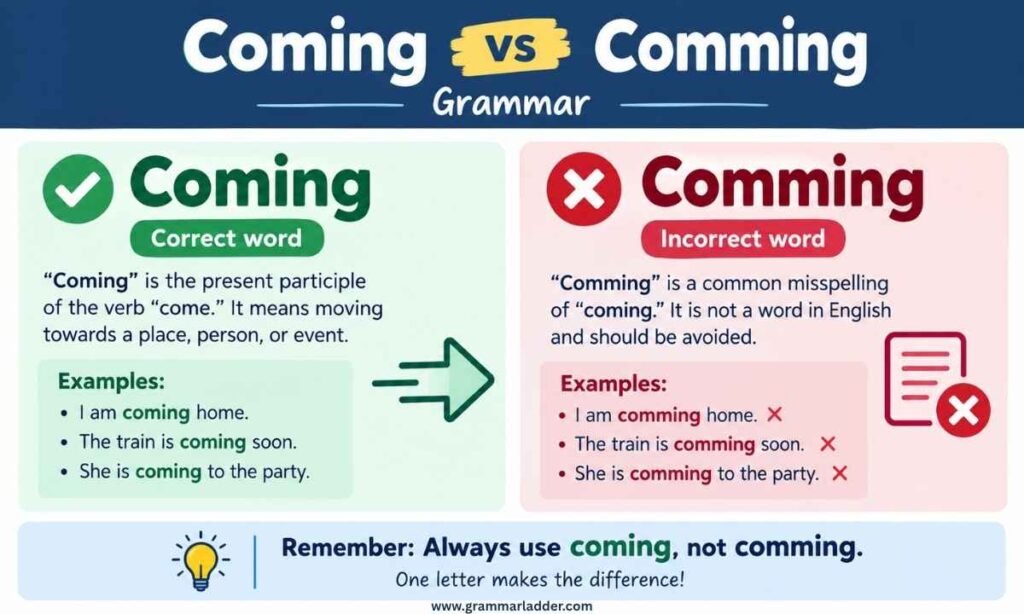
Understanding the grammar makes the spelling easier to remember. “Coming” can play several roles in a sentence:
- Present participle: used with a helping verb in continuous tenses (“She is coming.”)
- Gerund (verb as noun): “Coming early helps you get a good seat.”
- Adjective: “the coming year”
- Noun: “the coming of a new era”
Because it is built from the base verb “come,” the spelling must stay connected to that base. The word “comming” has no base verb “comm” behind it, which is another sign that it is wrong.
Comming or Coming UK?
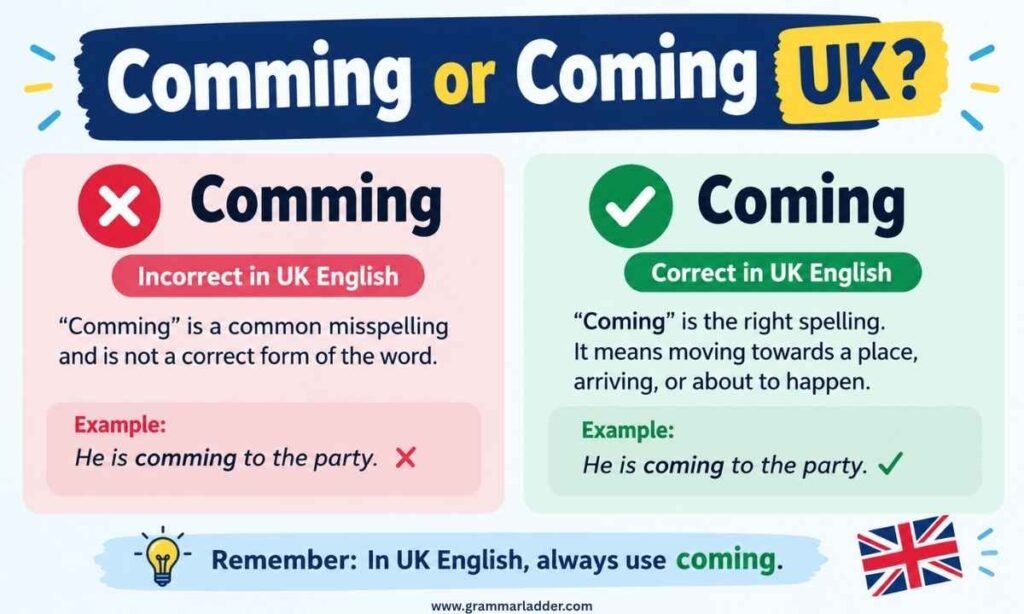
British English uses coming. There is no UK exception. Some people assume British spelling is more “complicated” and therefore allows extra letters, but the differences between British and American English are specific, such as colour/color or travelling/traveling. “Comming” is not one of them.
British dictionaries, including the Oxford and Cambridge references, list only “coming.”
Coming vs Comming Examples
Seeing the word in context helps the correct form stick. Here are correct sentences:
- “I am coming to the meeting at noon.”
- “Are you coming with us tonight?”
- “The coming week looks busy.”
- “She was coming home when the rain started.”
- “Good things are coming your way.”
And here are the incorrect versions to avoid:
- ❌ I am comming tomorrow. → ✅ I am coming tomorrow.
- ❌ The comming holidays are near. → ✅ The coming holidays are near.
- ❌ He kept comming back. → ✅ He kept coming back.
- ❌ Comming soon! → ✅ Coming soon!
When Did Comming Change to Coming?
There was no single moment of change. Before spelling was standardised, writers spelled words as they heard them. Old and Middle English texts show many variant forms of “coming,” and doubled letters in such variants were not unusual in early printed books.
As printing spread and dictionaries became popular, especially after Samuel Johnson’s dictionary in the 1700s, one consistent form won out. That form is “coming.” Today, “comming” survives only as an error, not as an accepted historical variant in modern usage.
Coming in Different Grammatical Uses
The word works in more ways than most learners expect.
Coming as a Verb Form
It appears in continuous tenses:
- Present continuous: “He is coming.”
- Past continuous: “They were coming.”
- Future continuous: “We will be coming tomorrow.”
Coming as an Adjective
It means “approaching” or “next”: “the coming elections,” “the coming months.”
Coming as a Noun
It refers to an arrival: “the coming of autumn.”
Common Phrases With Coming
These everyday expressions all use the correct spelling:
- Coming soon: announcing something that will be available shortly
- Coming up: about to happen
- Coming back: returning
- Coming along: making progress
- Coming of age: reaching maturity
- Coming out: being released or revealed
- Coming through: succeeding or arriving despite difficulty
- Coming to terms with: accepting a situation
- Coming apart: falling to pieces
If you ever want to write a movie poster, a shop sign, or a product launch banner, “Coming Soon” is the version to use.
Coming vs Comming in American English
American English follows the same rule as British English. Here is what to know:
- “Coming” is the standard spelling in the United States.
- “Comming” is not listed in American dictionaries such as Merriam-Webster.
- Word processors flag it as a spelling error.
- There is no regional split. Whether you write for readers in New York, London, or Sydney, the spelling stays the same.
Why Do People Spell Coming as Comming?
A few common reasons explain this mistake:
- The short vowel sound. “Com” sounds like it should have a double m, similar to “summer” or “hammer.”
- Confusion with doubling rules. Learners remember that “run” becomes “running” and apply the same rule to “come.”
- Typing speed. Fast typists sometimes double a letter by accident.
- Look-alike words. Words such as “comment,” “common,” and “committee” contain a double m, which can influence memory.
- Phonetic spelling. Writers sometimes spell what they hear, not what the rules say.
A Simple Trick to Remember Coming
Try this three-step memory check:
- Start with the base verb: come.
- Cross out the silent e: com.
- Add -ing: coming.
You can also remember this line: “Come loses its e, never gains an m.”
Another quick tip: count the m’s in the base word. “Come” has one m, so “coming” keeps one m.
Coming vs Comming: Common Mistakes
Besides the double m, writers make a few related errors:
- comming → extra m. Fix: coming
- comeing → the silent e was not dropped. Fix: coming
- cumming → wrong vowel, and it has a different meaning. Fix: coming
- commin → missing g. Fix: coming
Proofreading tip: Use a spell-check tool, but also read your text aloud. Tools sometimes miss errors in informal text, such as captions and hashtags.
Coming in Negative Sentences
Negatives use the same spelling. You simply add “not” or a contraction after the helping verb.
- “She is not coming to the party.”
- “They aren’t coming until Monday.”
- “I wasn’t coming to the office today.”
- “Nobody is coming to help.”
- “The bus isn’t coming on time.”
For questions in the negative, the spelling stays the same: “Aren’t you coming with us?”
Coming in Future-Related Expressions
“Coming” is very common when we talk about the future. It signals something near, expected, or scheduled.
- “The coming weeks” means the next few weeks.
- “Coming soon” means available in the near future.
- “What’s coming next?” asks about the next event.
- “I’ll be coming back next year” states a future return.
- “Big changes are coming” warns that change is approaching.
These phrases are popular in business writing, marketing copy, and news headlines, so correct spelling matters for your credibility.
How to Use Coming Correctly?
Follow this short checklist whenever you write:
- Check the base verb. If the base word is “come,” the form is “coming.”
- Remember the silent e rule. Drop the e before adding -ing.
- Match the helping verb. Use “am,” “is,” “are,” “was,” or “were” with “coming.”
- Avoid doubling letters unless the word follows the short vowel plus single consonant pattern, without a silent e.
- Proofread public text. Headlines, signs, ads, and website titles deserve a second look.
Writers, teachers, and editors have long relied on this approach, and it works for most -ing forms.
Frequently Asked Questions
Is it “coming” or “comming”?
It is “coming.” “Comming” is always a misspelling.
Is “comming” ever correct in British English?
No. British English also uses “coming” only.
Why does “come” lose its e before -ing?
English drops a silent e before adding -ing to keep the word easy to read and pronounce.
Is “coming” a noun or a verb?
It can be both. It is a verb form in “She is coming,” and a noun in “the coming of spring.”
What is the past tense of “coming”?
“Coming” is not a past tense. The past tense of “come” is “came,” and “come” is the past participle.
Does “coming soon” need a capital letter?
Only in titles or headings, such as “Coming Soon” on a poster.
What is a simple way to remember the spelling?
Drop the e from “come” and add -ing. No second m is needed.
Conclusion
The coming vs comming debate has a clear winner. “Coming” is the correct spelling in both British and American English, and “comming” is simply a common typing and spelling slip. The rule is easy to remember: drop the silent e from “come,” add -ing, and keep a single m.
The same shortcut works for words like “making,” “taking,” and “writing,” so one rule covers many spellings. Clean writing builds trust with readers, and a few seconds of proofreading is all it takes to look careful, professional, and confident.

I am an English writer with over four years of experience in grammar and language education.
Through Grammar Ladder, I share clear explanations, practical examples, and helpful English tips.
My goal is to share my knowledge so others can benefit and improve their language skills.
I believe anyone can master English with proper guidance and consistent practice.