Ever paused mid-sentence, unsure whether to type “pricey” or “pricy”? You’re not alone. This is one of those small spelling puzzles that trips up even confident English speakers and writers, especially since spell-checkers don’t always flag the “wrong” one.
The good news is that the answer is simple once you know the rule. In this guide, you’ll learn exactly which spelling to use, why both exist in the first place, and how native speakers and major style guides treat this word today.
Quick Answer
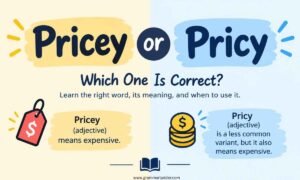
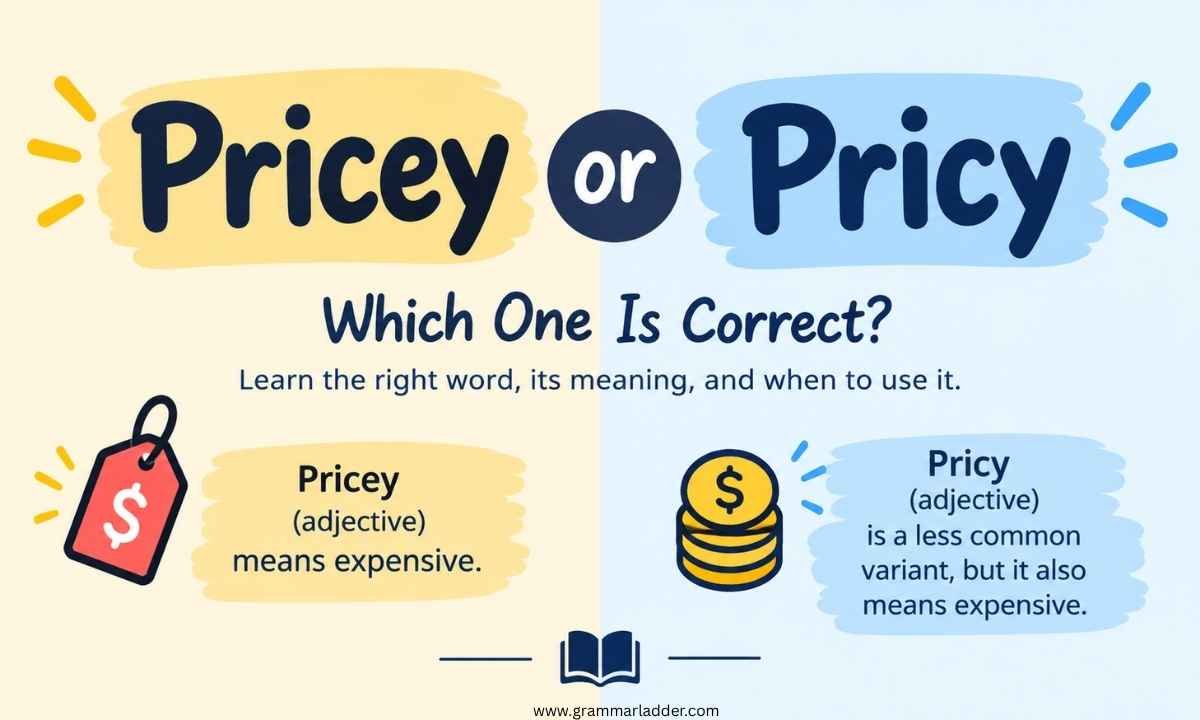
“Pricey” is the correct and more widely accepted spelling. It’s the version favored in American English, British English, and virtually every major dictionary and style guide.
“Pricy” is not incorrect — it’s a recognized variant spelling — but it’s far less common and can look like a typo to most readers. If you want to play it safe in any formal, academic, or professional writing, go with “pricey.”
Meaning and Definition of Each Word
Before comparing the two spellings, it helps to understand what the word actually means. Both forms describe something that costs more than expected or more than average — in short, something expensive.
Pricey
“Pricey” is an informal adjective meaning expensive, often used to describe something that feels like a lot of money relative to its value. It usually carries a slightly casual or conversational tone rather than a strictly technical one.
Example meaning: A dinner, gadget, or vacation that costs more than you’d like to spend could be described as pricey.
Pricy
“Pricy” carries the exact same meaning as “pricey” — expensive or costly. It’s simply an alternate spelling, not a different word with a different definition. Some dictionaries list it as a secondary or informal variant, while others don’t include it at all.
Key Differences Between the Words
There isn’t a difference in meaning between “pricey” and “pricy.” The real differences lie in usage, frequency, and formality:
- Popularity: “Pricey” appears far more often in books, news articles, and everyday writing than “pricy.”
- Formality: “Pricey” is the standard choice recommended by most editors and style guides.
- Regional acceptance: Both American and British English favor “pricey,” though “pricy” occasionally appears in casual or regional writing.
- Etymology: Both come from the noun “price” plus the adjective-forming suffix “-y,” a pattern that dates back to the early 20th century.
Comparison Table
| Feature | Pricey | Pricy |
| Meaning | Expensive, costly | Expensive, costly |
| Popularity | Much more common | Rare, less common |
| Preferred in dictionaries | Yes (primary spelling) | Listed as a variant only |
| Formal writing | Recommended | Best avoided |
| American English | Standard | Accepted but uncommon |
| British English | Standard | Accepted but uncommon |
| Word origin | Price + “-y” | Price + “-y” |
Examples in Sentences
Seeing both words in context makes the distinction even clearer.
Using “Pricey”
- The new smartphone looks great, but it’s a bit pricey for a budget upgrade.
- Downtown apartments have gotten noticeably pricey over the last few years.
- That restaurant has amazing food, though the menu is definitely pricey.
- Designer handbags are pricey, but they tend to hold their value.
- Flights during the holiday season are always pricey.
Using “Pricy”
- The hotel was lovely but a little pricy for a short weekend trip.
- Some readers still prefer the shorter spelling, “pricy,” in casual notes and messages.
- The boutique’s clothing is pricy compared to the shops nearby.
Notice how both words work identically in a sentence. Swapping “pricey” for “pricy” (or vice versa) doesn’t change the meaning at all — only the visual familiarity of the spelling changes.
Pricy or Pricey in Tagalog
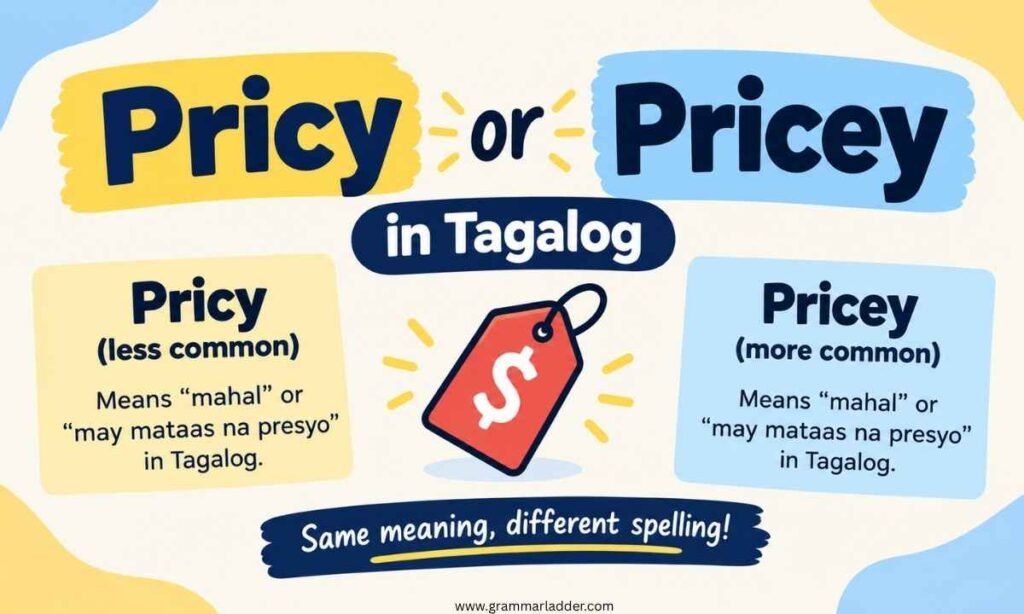
In Tagalog and Filipino English, both spellings are understood, but “pricey” is the version most commonly used in conversation, social media captions, and product reviews. Filipinos often borrow the word directly rather than translating it, since Tagalog doesn’t have a single-word equivalent that captures the same casual tone. A close translation would be “mahal” (expensive), but “pricey” is frequently used as-is, especially online — for example, “Medyo pricey yung item na ito” (This item is a bit pricey).
Pricy or Pricey Artinya
For Indonesian and Malay speakers searching for the meaning (“artinya” means “its meaning” in Indonesian), “pricey” and “pricy” both translate to “mahal,” meaning costly. The word is commonly borrowed into casual Indonesian conversation and social media, particularly when reviewing products, food, or travel costs. As with English, “pricey” is the spelling you’ll see used most often in Indonesian blogs and online marketplaces.
Pricy or Pricey UK
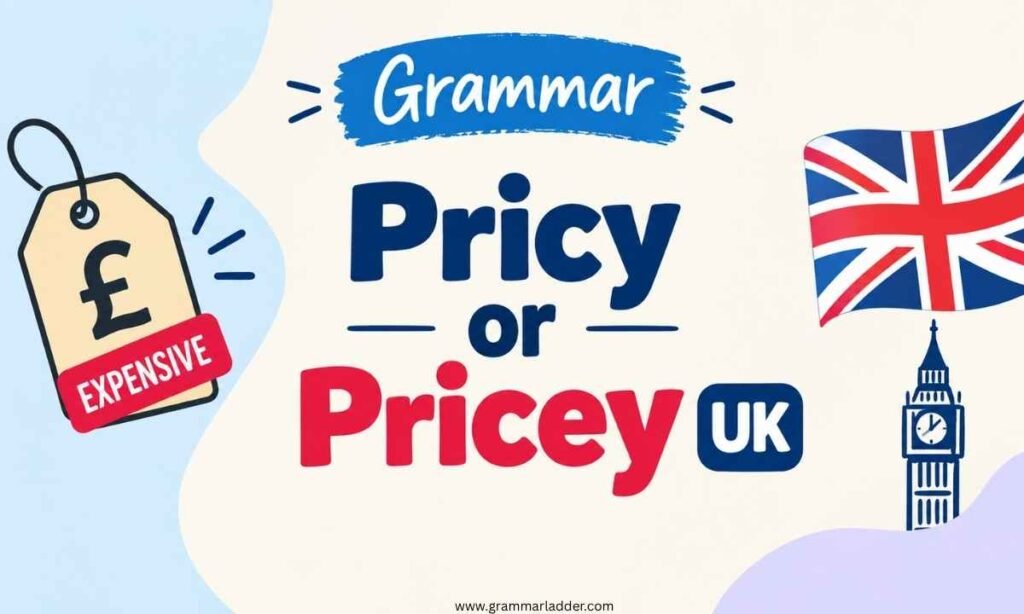
British English speakers and publications overwhelmingly favor “pricey” as well. Major UK dictionaries and news outlets consistently use the “-ey” spelling, and it’s the version taught in British schools and style guides. “Pricy” isn’t considered wrong in the UK, but it’s treated as an unusual or dated variant rather than a regional preference. If you’re writing for a British audience — whether it’s a blog post, marketing copy, or a formal document — “pricey” is the safer and more professional choice.
Common Mistakes
Even experienced writers slip up with this word. Here are the most frequent errors to watch for.
1. Thinking Both Are Equally Correct Everywhere
While both spellings technically exist, they’re not equally accepted in every context. “Pricey” is the standard; “pricy” is the exception. Using “pricy” in a formal report or academic paper can come across as a typo rather than a stylistic choice.
2. Assuming “Pricy” Is Wrong
On the flip side, some writers assume “pricy” is a spelling error and correct it unnecessarily. It’s a valid, dictionary-recognized variant — just not the preferred one.
3. Spelling Errors
Because the word doesn’t follow the same pattern as similar words like “spicy” or “icy” (which drop the silent “e”), people often misspell “pricey” as “pricy” by habit, applying the wrong rule from a similar-looking word.
4. Using the Wrong Tone
Both “pricey” and “pricy” are informal words. Using either one in highly formal or technical writing — like legal documents or scientific reports — can feel out of place. In those contexts, “expensive,” “costly,” or “high-priced” are better fits.
Tips to Remember the Difference
- Think of “pricey” as the “default” spelling — when in doubt, add the “e.”
- Remember that English has no strict rule for words ending in “-y” after a silent “e.” Some drop it (“spicy,” “dicey”), and some keep it (“pricey”). “Pricey” is simply the exception that stuck.
- If your spell-checker doesn’t flag “pricey,” that’s a good sign it’s the safer choice.
- When writing for search engines, blogs, or general audiences, stick with “pricey” since it’s what most readers expect and recognize instantly.
When to Use Each Word
Use “Pricey” When:
- Writing for a general or professional audience
- Creating blog content, marketing copy, or product reviews
- You want your writing to look polished and error-free
- You’re unsure which spelling to choose (it’s the safer default)
Use “Pricy” When:
- Quoting someone who used that specific spelling
- Writing very casual, personal notes where exact spelling isn’t critical
- You’re intentionally matching an older or regional text that used this variant
Grammar Rules (If Applicable)
“Pricey” and “pricy” are both adjectives, formed by adding the suffix “-y” to the noun “price.” Normally, when a word ends in a silent “e,” English drops the “e” before adding “-y” (as in “spice” → “spicy,” “ice” → “icy”). “Pricey” breaks that pattern by keeping the “e,” most likely to avoid confusion with the unrelated word “pricy” looking like it should rhyme differently, or simply because that spelling became the accepted convention over time.
Like other adjectives, “pricey” can be used comparatively and in superlative form:
- Pricey → pricier → priciest
Note that when adding suffixes like “-er” or “-est,” the “e” is dropped: “pricier,” not “priceyer.”
Synonyms or Related Words
If you want to avoid repeating “pricey” or “pricy” too often in your writing, consider these alternatives:
- Expensive
- Costly
- High-priced
- Overpriced
- Steep (informal)
- Extravagant
- Exorbitant
- Premium-priced
Frequently Asked Questions
Is “pricy” a real word?
Yes, “pricy” is a recognized variant spelling of “pricey,” though it’s far less commonly used.
Which spelling should I use in professional writing?
Always use “pricey” in professional, academic, or formal writing for consistency and clarity.
Do British and American English spell it differently?
No, both British and American English prefer “pricey” over “pricy.”
What does “pricey” mean?
“Pricey” means expensive or costing more than expected.
Is “pricy” grammatically incorrect?
No, it’s not incorrect — it’s simply an uncommon variant of “pricey.”
Why does “pricey” keep the “e” while similar words don’t?
English spelling isn’t fully consistent; “pricey” retained the “e” by convention, unlike words such as “spicy” or “icy.”
Can I use “pricier” and “priciest”?
Yes, these are the correct comparative and superlative forms of “pricey.”
Conclusion
When it comes to “pricey or pricy,” the choice is clear: “pricey” is the standard, widely accepted spelling used across American English, British English, and everyday digital communication worldwide. “Pricy” isn’t wrong, but it’s rare enough that using it may distract readers or look like a typo.
For blogs, business writing, social media, or anything meant for a broad audience, stick with “pricey.” It’s the version dictionaries favor, the version readers expect, and the version that keeps your writing looking polished and professional.

I am an English writer with over four years of experience in grammar and language education.
Through Grammar Ladder, I share clear explanations, practical examples, and helpful English tips.
My goal is to share my knowledge so others can benefit and improve their language skills.
I believe anyone can master English with proper guidance and consistent practice.