Have you ever typed “thier” and then paused, unsure if it looked right? You’re not alone. It’s one of the most common typing slips in English, and even confident writers make it.
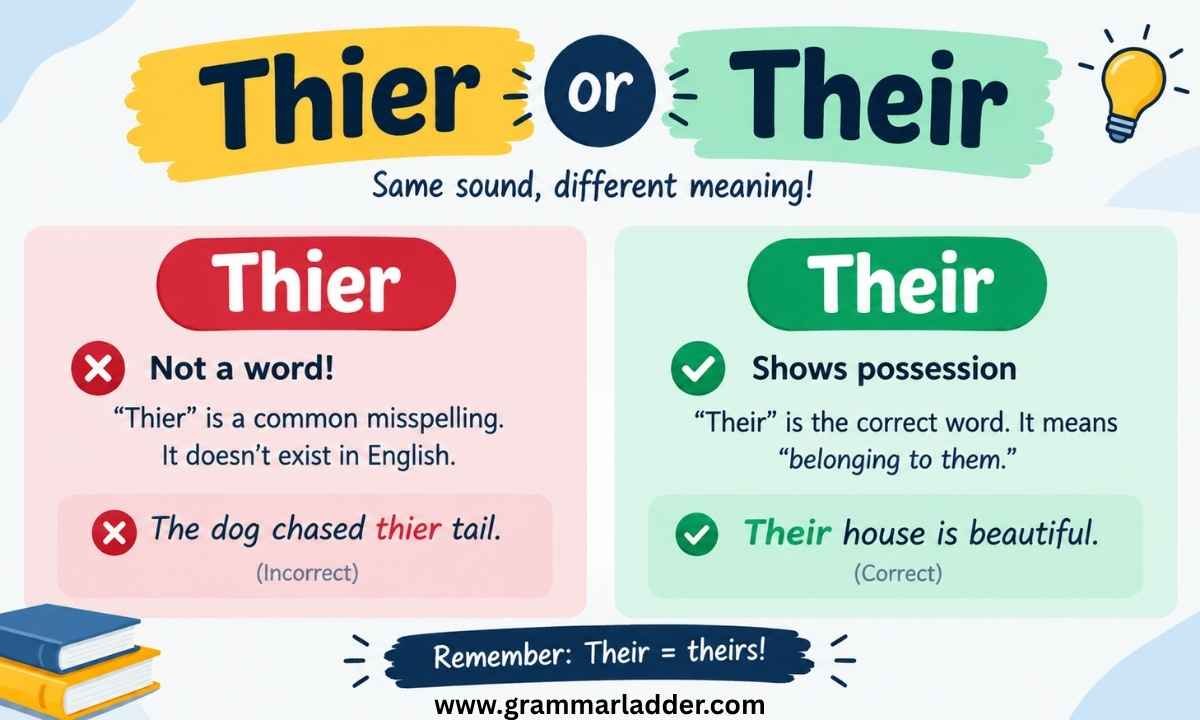
The truth is simple. “Their” is the only correct spelling. “Thier” is just a letter mix-up with no real meaning. In this guide, we’ll clear up the confusion for good, with easy tips to help it stick.
Quick Answer
- “Their” is the correct spelling.
- “Thier” is simply a misspelling—it has no meaning in English.
- It won’t appear in any dictionary, standard or otherwise.
- If you’re ever unsure which one to type, the safe choice is always their.
Simple Background
English has many tricky words. “Their” is one of them. The letters “e” and “i” often swap places by accident. This word also sounds just like “there” and “they’re.” That makes it even easier to mix up. But once you learn the simple rule, the mistake goes away for good.
Clear Explanation of the Difference
What is “Their”?
“Their” is a possessive pronoun. It shows that something belongs to more than one person. It works like “his,” “her,” or “its,” but for groups.
Examples:
- The kids packed their bags.
- The team shared their results.
- Birds build their nests.
What is “Thier”?
“Thier” is not a real word. It has no meaning. It has no dictionary entry. It shows up only as a typo. Most people type it by accident when they swap the “e” and “i.”
Comparison Table
| Feature | Their | Thier |
| Part of speech | Possessive pronoun | Not a real word |
| Dictionary entry | Yes | No |
| Meaning | Belonging to them | No meaning |
| Correct to use? | Yes, always | No, never |
| Common cause | N/A | Typing speed, letter swap |
Which One to Use and When
“Thier” is never correct. So the real challenge is choosing between their, there, and they’re.
- Use their to show ownership: their bag, their house
- Use there to show a place: Put it there.
- Use they’re to mean “they are”: They’re happy.
Simple Tip to Remember
Look closely at the word “their.” It hides the word “heir” inside it. An heir inherits things. That’s a hint that their is about ownership.
Another easy test: try saying “they are” instead. If it still makes sense, use they’re. If not, use their.
Common Mistakes People Make
1. Reversing letters
Many people swap the “e” and “i” by mistake. This turns “their” into “thier.” It’s usually just a typing slip.
2. Confusing with other similar words
“Their,” “there,” and “they’re” all sound the same. That makes them easy to mix up, even for careful writers.
3. Typing too fast
Fast typing leads to small errors. Letters get flipped without notice. This is one of the top reasons “thier” appears in texts and emails.
Thier or Their Grammar
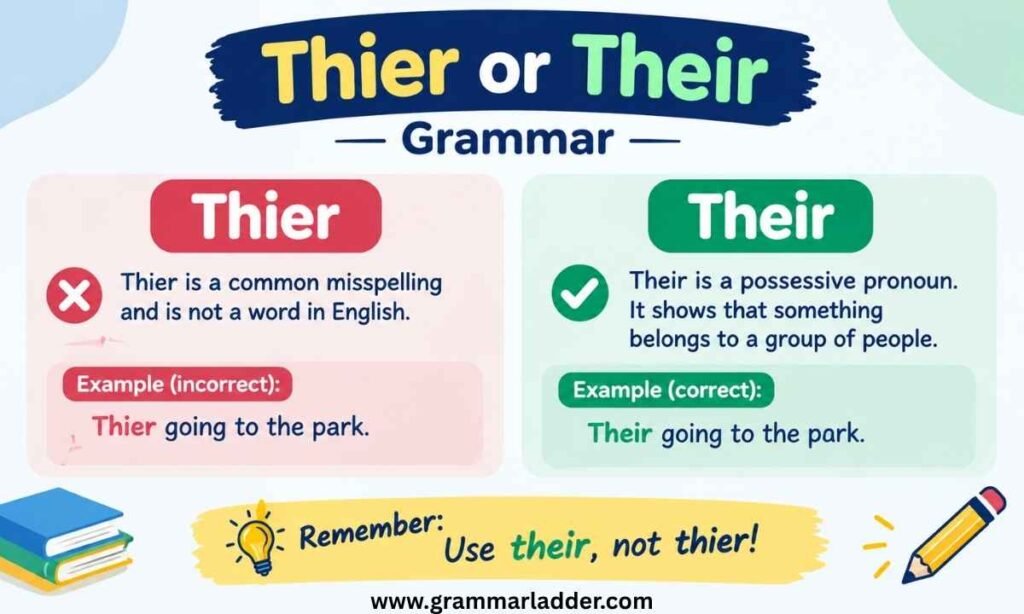
“Their” is a possessive determiner. It always comes before a noun. It shows that something belongs to a group. “Thier” has no grammatical role. It simply isn’t a word.
Thier or Their Meaning
“Their” means “belonging to them.” That’s it. It shows shared or group ownership. “Thier” means nothing. It is not an old form or a regional spelling. It’s simply a mistake.
Thier or Their Quiz
Fill in the blank with the correct word:
- The kids left ___ shoes by the door.
- Is that ___ car parked outside?
- Staff must wear ___ badges.
- The cat licked ___ paw.
- ___ plans changed last minute.
Answer: Every blank should be their. “Thier” is never correct.
Thier or Their Meaning Oxford
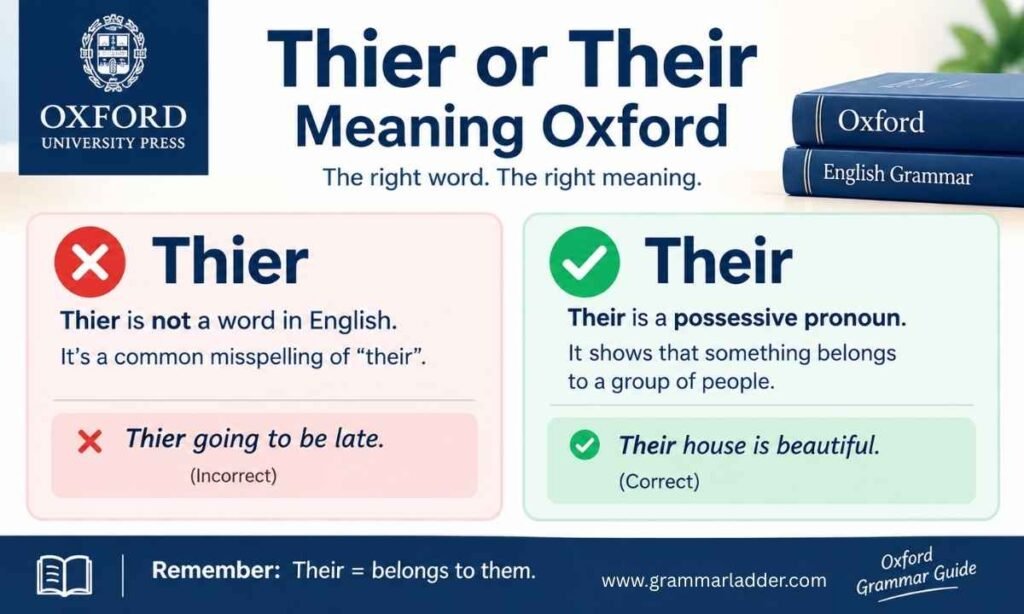
Oxford defines “their” as belonging to a group of people, animals, or things. It can also be used for one person when gender is unknown. “Thier” has no entry in Oxford or any other dictionary.
Thier or Their: I Before E Except After C
Some people use this rhyme to guess the spelling. They think it should be “thier.” But this rule doesn’t apply here. English has many exceptions, like “weird” and “seize.” The best fix is simple: just remember that their is always correct.
Everyday Real-Life Examples
In Emails
“Please review their updated proposal.”
In Messages
“Send me their number when you can.”
On Social Media
“So proud of their big win today!”
In Daily Life
“They painted their fence last weekend.”
Short Learning Section for Students
Step 1: Learn the correct form
Only one spelling is correct: their.
Step 2: Practice
Write a few short sentences using “their.” Practice helps it stick.
Step 3: Use a memory trick
Remember “heir” hides inside “their.” That links it to ownership.
Step 4: Check spelling
Always double-check before you send or submit your writing.
Frequently Asked Questions
Is “thier” correct in British English?
No. It’s incorrect in every form of English.
Why do people misspell “their” as “thier”?
Mostly from fast typing or letter reversal.
Does spellcheck catch “thier”?
Yes. Most tools flag it right away.
What’s an easy way to remember the spelling?
Think of the word “heir” hidden inside “their.”
Is “their” only for groups?
No. It’s also used for one person when gender is unknown.
Conclusion
The answer is simple. “Their” is always correct. “Thier” is always a mistake. Just remember the hidden word “heir” inside “their.” That small trick can help you spell it right every time.

I am an English writer with over four years of experience in grammar and language education.
Through Grammar Ladder, I share clear explanations, practical examples, and helpful English tips.
My goal is to share my knowledge so others can benefit and improve their language skills.
I believe anyone can master English with proper guidance and consistent practice.