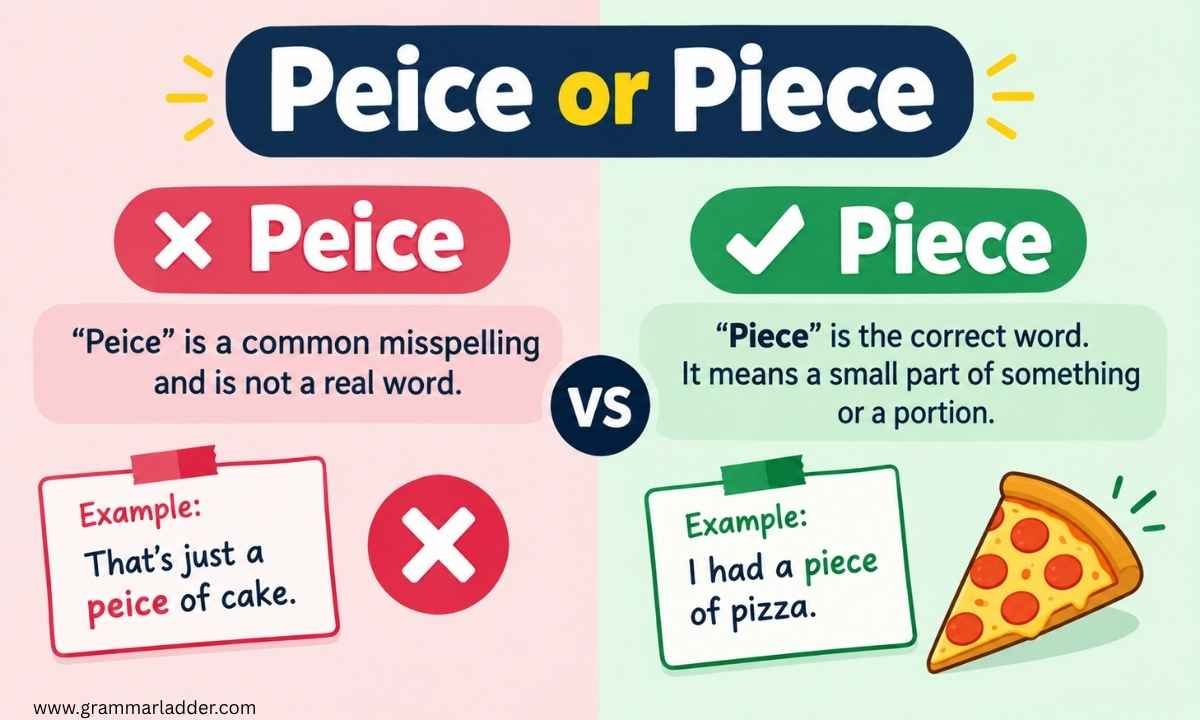
Have you ever typed “peice” and then paused? You’re not the only one. This word confuses a lot of people, even good writers.
The mix-up happens because of two tricky letters: “i” and “e.” They look alike. They sound alike. But only one order is correct. This guide will clear up the confusion for good.
Quick Answer
- “Piece” is the correct spelling.
- “Peice” is simply a common misspelling and has no meaning in standard English.
- Whether you’re writing an email, a school essay, or a social media caption, always go with piece.
- Example uses: “a piece of cake” or “a piece of advice.”
Simple Background
English spelling can be tricky, especially when two vowels sit next to each other. Words like piece, believe, receive, and achieve often confuse writers because the “ie” and “ei” combinations look so similar. This mix-up is exactly why so many people type “peice” instead of “piece” without even noticing the error.
The confusion usually comes from typing speed, muscle memory, or simply never learning the classic spelling rule that governs these letter pairs. The good news is that once you understand the rule, you’ll never second-guess this word again.
Clear Explanation of the Difference
What is “Piece”?
Piece is a standard English noun that refers to a part or portion of something larger. It can also function as a verb, meaning to put something together (as in “piece together evidence”).
Examples:
- She ate a piece of chocolate cake.
- He gave me a piece of useful advice.
- The puzzle is missing one piece.
This is the only version found in dictionaries, textbooks, and professional writing.
What is “Peice”?
Peice is not a real word. It doesn’t appear in any recognized English dictionary, and it holds no independent meaning. It’s simply the result of swapping the order of “i” and “e” — a mistake that happens easily because both letters make similar sounds when read quickly.
If you’ve typed “peice” before, you’re not alone. It’s one of the most frequently searched spelling errors in English.
Comparison Table
| Feature | Piece (Correct) | Peice (Incorrect) |
| Dictionary status | Valid English word | Not a recognized word |
| Meaning | A part or portion of something | No meaning |
| Usage in writing | Accepted everywhere | Considered a spelling error |
| Pronunciation | /piːs/ (sounds like “peace”) | Not applicable |
| Common in | Books, articles, emails, exams | Typos, casual texts, quick typing |
| Grammar check tools | Marked correct | Flagged as an error |
Which One to Use and When
The answer is simple: always use “piece.” There is no context — formal, informal, academic, or professional — where “peice” is acceptable. Whether you’re writing a resume, a text message, or a blog post, “piece” is the only correct choice.
Simple Tip to Remember
The easiest way to remember this spelling is through a classic phrase many students learn in school:
“I before E, except after C.”
Since there’s no “c” before the “ie” in this word, the “i” comes first: p-i-e-c-e.
Another helpful trick is linking the word to its pronunciation. “Piece” sounds exactly like “peace” (as in calm and quiet). If you can spell “peace” correctly, just remember that “piece” follows the same “ie” pattern, only with a “p” at the start and a slightly different meaning.
Common Mistakes People Make
Even confident writers slip up with this word. Here are the three biggest reasons this error happens.
1. Reversing the letters
The most common mistake is simply flipping the “i” and “e,” turning “piece” into “peice.” This usually happens due to fast typing rather than a lack of knowledge.
2. Forgetting spelling rules
Many people never fully learned or remember the “i before e” rule, so they guess the spelling based on how the word sounds rather than how it’s actually written.
3. Typing too fast
Autocorrect doesn’t always catch this error, especially on mobile keyboards where predictive text sometimes accepts unusual letter combinations. Typing in a hurry — during chats or quick social media posts — makes this mistake more likely.
Peice or Piece in English
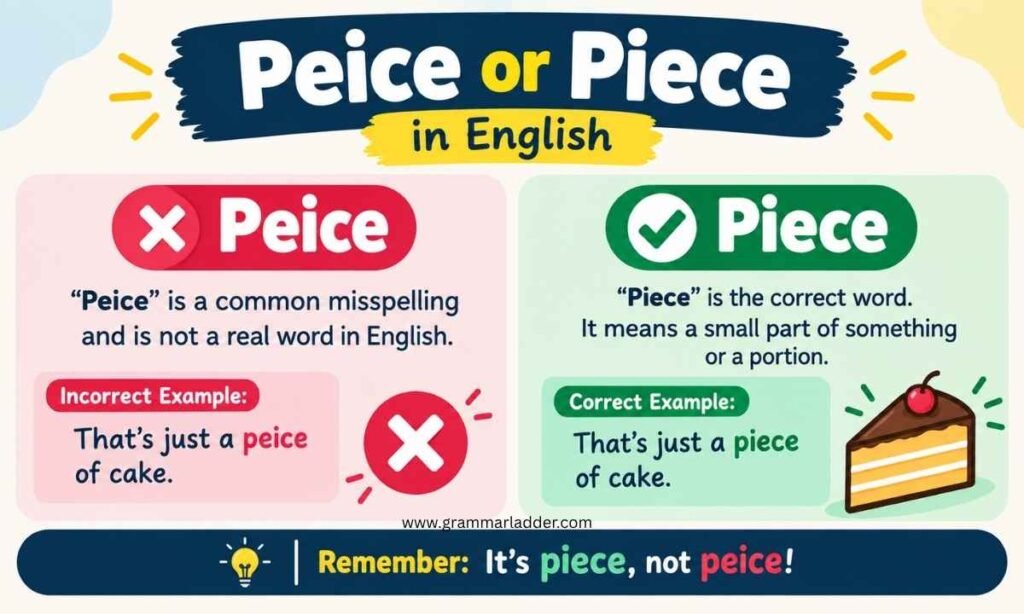
In standard English, piece is the universally accepted spelling. It’s used in literature, journalism, business writing, and everyday conversation. “Peice” does not appear in any English dictionary, style guide, or grammar reference, which confirms it is purely a typographical error rather than an alternate spelling or regional variation.
Peice or Piece Meaning
The meaning belongs entirely to “piece,” which can refer to:
- A portion or part of something (a piece of pie)
- A single item in a set (a chess piece)
- A written or artistic work (a piece of music)
- An example of something abstract (a piece of advice)
“Peice” carries no meaning because it isn’t a real word.
Peice or Piece Pronunciation
Both spellings, if pronounced, would sound the same: /piːs/, rhyming with “peace” and “lease.” However, only “piece” is the correct written form. Pronunciation alone won’t help you spell this word correctly since the sound doesn’t reveal which vowel comes first — that’s why the spelling rule matters more here than phonetics.
Peice or Piece of Art
When referring to artwork, the correct phrase is always “a piece of art.” This term is widely used in galleries, art critiques, auction listings, and everyday conversation to describe paintings, sculptures, or any creative work. Writing “a peice of art” is a spelling mistake that can undermine credibility, especially in professional or academic writing about art and culture.
Everyday Real-Life Examples
In Emails
“Please find attached the final piece for your review before we submit it to the client.”
In Messages
“Can you send me that piece of information you mentioned earlier?”
On Social Media
“Just finished this piece for my portfolio — so proud of how it turned out! 🎨”
In Daily Life
“Could you hand me that last piece of pizza?”
Notice how “piece” fits naturally into casual, professional, and creative contexts alike — proof of just how common and versatile this word is.
Short Learning Section for Students
If you’re a student trying to lock this spelling into memory, follow these four simple steps.
Step 1: Learn the correct spelling
Start by writing “piece” several times on paper or typing it slowly. Repetition builds familiarity faster than passive reading.
Step 2: Practice
Use the word in different sentences:
- “I need one more piece of the puzzle.”
- “That was a beautiful piece of writing.”
- “He broke the bar into two pieces.”
Step 3: Use a memory trick
Remember the rhyme: “I before E, except after C.” Since there’s no “c” here, “i” leads the way.
Step 4: Check your writing
Always proofread your work, or run it through a spell-checker, before submitting essays, assignments, or emails. Catching small errors early builds stronger writing habits over time.
Frequently Asked Questions
Is “peice” ever correct in any English dictionary?
No, “peice” is not listed in any recognized English dictionary and is always considered a spelling mistake.
Why do people confuse piece and peice?
The confusion comes from the similar-sounding “ie” and “ei” letter combinations and fast typing habits.
What is the rule for spelling piece correctly?
The rule is “I before E, except after C,” and since there’s no “c” before it, “piece” is spelled with “i” first.
Does piece rhyme with peace?
Yes, both words are pronounced the same way: /piːs/.
Can “peice” be a regional or British spelling variation?
No, “piece” is the only accepted spelling in both American and British English.
What does “a piece of art” mean?
It refers to a single work of art, such as a painting, sculpture, or creative piece.
How can I avoid misspelling piece in the future?
Practice writing the word, use the “I before E” rule, and always proofread before finalizing your text.
Conclusion
The correct spelling is always “piece,” never “peice.” This simple word trips up even experienced writers because of how easily the “i” and “e” can be swapped during quick typing. By remembering the classic rule “I before E, except after C” and practicing the word in everyday sentences, you can permanently avoid this common mistake.
Whether you’re writing a professional email, a school assignment, or a quick social media post, using the correct spelling shows attention to detail and strengthens your overall writing credibility. Keep this guide handy, and you’ll never confuse piece and peice again.

I am an English writer with over four years of experience in grammar and language education.
Through Grammar Ladder, I share clear explanations, practical examples, and helpful English tips.
My goal is to share my knowledge so others can benefit and improve their language skills.
I believe anyone can master English with proper guidance and consistent practice.